 Chad Kempel
Book Chad
Chad Kempel
Book Chad
Chad Kempel
Book Chad
Chad Kempel
Book Chad
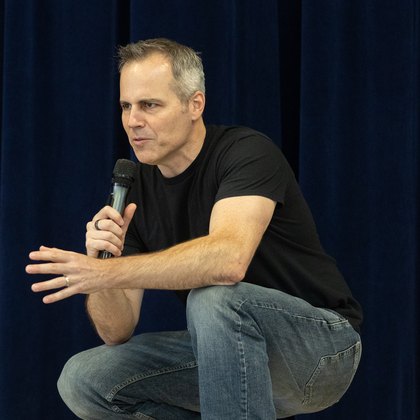
The Weight You’re Carrying is Chad Kempel’s mental health assembly for high schools. Most speakers tell students what to do. This one tells them what’s happening inside them, gives it a name, and hands them a tool they can use before they go to bed. From a 4x Guinness World Records holder with an MA in Experimental Psychology. Based in Boise, booking nationwide.
Local Introductory Rate: $1,000 per assembly · See what’s included ↓Students who most need a mental health assembly are the ones most likely to tune out the moment they hear the words. No warning-sign slideshow, no lecture. Chad opens with a physical image, what it feels like to push 300 pounds for 26.2 miles, and then asks the only question that matters: what are you pushing right now that nobody in this room can see?
From there the talk covers the things your counselors see every week: anxiety, loneliness, substance use and grief. Each one gets a plain name students can use, and a tool small enough that they will actually try it.
Chad taught psychology and statistics at San Jose State University for five years. The psychology isn’t a line in his bio. It’s the engine of every story in the talk.
Chad was teaching a college class when his phone rang and he found out he was losing his twin sons, Marshall and Spencer. It’s where students first hear what cognitive load feels like from the inside.
A run past every landmark of his life, including the eighth-grade locker room where his body locked up. Students learn why the freeze response happens and that it isn’t weakness. Read the full story: Why You Freeze Under Pressure.
A coworker who struggled with drug addiction and died by suicide at 29. Students learn why weight that has nowhere to go comes out sideways.
One sentence written that night, and a sheet each student takes home.
Each one taught through the story, each one paired with something students can do before tomorrow.
The invisible weight your brain is carrying. It’s why everything feels harder than it should.
Cognitive offloading. Write one thing down. Your brain relaxes when it doesn’t have to hold it anymore.
Your body locks up. You can’t move, speak or react. It’s your nervous system trying to protect you.
Affect labeling plus 5-4-3-2-1 grounding. Say "this is my freeze response," then name five things you see, four you can touch, three you hear.
The weight comes out sideways: as anger, as withdrawal, as the thing you can’t explain to your parents.
The one-question pause. Before you react, ask: "Is this actually about this person?" The pause is the tool.
Struggle can rebuild who you are. It doesn’t happen automatically. It’s chosen.
The one-sentence turn. Tonight, finish this: "What this hard thing has started to teach me is ___."
Before they leave, every student gets a sheet with a few lines to fill out. Nobody has to see it but them. It turns the assembly into something they do, not just something they heard.
No travel fee for schools within a few hours of Boise. Anywhere else in the U.S. or abroad, send your dates for a quote within 48 hours.
Check Your Date →The Weight You’re Carrying stands on its own and is the second talk in a series. Anything Is Possible is the resilience assembly, The Weight You’re Carrying is the mental health assembly, and I Walked the Hallways Alone is the anti-bullying and belonging assembly. Or see all three talks and pricing.
Discovery calls available · Replies within 48 hours · Based in Boise, booking nationwide
Check Your Date →From Insights
Ever locked up right when you needed to move? I did, in an eighth-grade locker room. What the freeze response is, and how to break it.
Read the article →Get the free 10-principle guide.
Subscribe and get Anything Is Possible Was Never the End of the Sentence: 10 principles pulled from real moments, for anyone still figuring it out. Then one email when a new Insights article goes up. Unsubscribe anytime.