What should you do after you fail?
Figure out exactly how short you fell and why, then pick your next try before the disappointment talks you out of it. The gap is useful information. The feeling is just loud.
In 2019 I went after a Guinness World Records title for the fastest marathon pushing a quintuplet stroller. My quintuplets had just turned a year old, and between the five of them and the stroller I was pushing about 200 pounds. They loved being out there, and I loved having them with me. I've always cherished that time, and I always will.
The time I had to get under was 4 hours and 45 minutes. For a regular marathon, that's not fast. A lot of weekend runners finish under that, but they also aren't steering five babies through a crowd.
My first shot was the Surf City Marathon in Huntington Beach on February 3rd, less than a month after their first birthday. We drove down from the Bay Area, I'd put in the training, and I honestly felt ready.
At the start in Huntington Beach, a guy on a bike seemed to come out of nowhere. "My name's Lenny. I'm going to be with you the entire way. There's nothing to worry about." That was Lenny Isaacs of SoCal Bike Escorts, which the Surf City race director had brought in for the event. Lenny rides alongside wheelchair athletes, challenged athletes, and anybody else who needs support through a full marathon. He meant every word. He helped with bottle feeds, told me stories to keep me going, and never left our side.
Then a torrential downpour and the hills showed up, and a 200-pound stroller doesn't care how ready you feel.
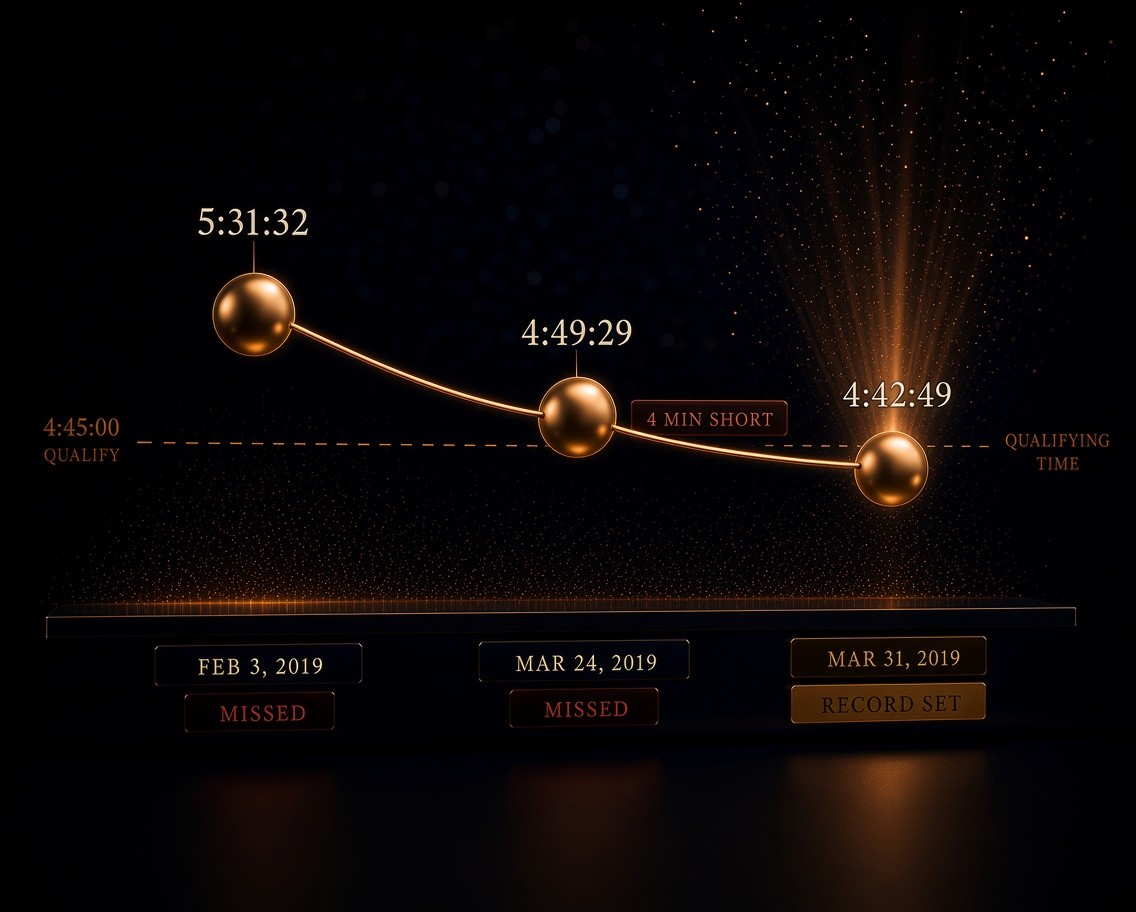
I finished in 5:31:32. Forty-six minutes over. That's not close, not even in the same zip code as close, and my legs were so wrecked that my wife, Amy, had to drive us home.
Somewhere before we got to the freeway, I had my phone out looking for the next marathon.
I wasn't feeling great about it. But I knew why I'd missed, and it was the course, not my training. Sitting on the couch wasn't going to flatten any hills.
Seven weeks later, on March 24th, we lined up at the Oakland Marathon, and I couldn't have been more fired up. The start was just a few exits down the freeway from San Lorenzo, the town where I grew up and lived until I was about 16. I'm an A's fan, so all five kids were in A's jerseys. Setting a world record that close to home was going to be so cool.
I knew the course was new that year. For the first time, the marathon went up the Bay Bridge to Yerba Buena Island and back. What I didn't know was how different that long, gentle climb feels when you're pushing five kids instead of driving it. My quads were on fire. My brother, Steven Kempel, was riding his bike right beside us, and I told him, "If I ever tell you later that this wasn't that bad, tell me I'm lying."
I didn't walk a single step of that climb. At the turnaround I figured every uphill has a downhill, and I'd get all that time back coming off the bridge. I'm using the word downhill loosely. It was barely a slope.
Still, I thought I was on schedule. Then around mile 24 the pain in my legs got so bad that I started switching between running and walking, and every time I walked, I could feel the record slipping further away.
The pain wasn't even the worst of it. The worst was knowing what a miss meant: weeks of getting the stroller and the kids ready, a 4 a.m. alarm, feeding and changing five babies at the start line, then a long drive home with everybody wiped out. All of it again. I remember thinking, I don't know how many more times I can do this.
I finished in 4:49:29.
Four minutes and 29 seconds over.
That one was worse, mentally and physically. Forty-six minutes is a different planet. Four minutes is close enough to taste. If you've ever missed a team by one spot or a grade by two points, you know the feeling. Spread it over 26.2 miles and it comes out to about ten seconds a mile, which is one long drink at an aid station, or stopping to change a diaper.
I was frustrated with myself, but I knew exactly what had beaten me, and it was that bridge. I needed a flat course. As it happened, I had a backup to my backup: the Modesto Marathon, seven days away, out in the farmland and completely flat. A year earlier, Ann Marie Cody had set the record for the fastest marathon pushing a triple stroller on that exact course. That same day I emailed the race director and asked if I could make my attempt in Modesto the next weekend. They said yes almost right away.
Then I went home, sat in an ice bath, and looked up everything I could find on recovering from a marathon in a week. I did all of it. Stayed off my feet as much as I could and made sure my nutrition was dialed in for recovery.
Anybody who knows running will tell you not to race two marathons a week apart. Standing on the start line in Modesto, I had no idea how my legs would hold up over the next 26.2 miles.
Steven was back on his bike next to his nieces and nephews for every mile again. I can't tell you how good it was to have him out there. That first year of raising five babies and two other little kids at home was about as hard as it gets, and here I was, twice in one week, spending a whole morning on a race course with my brother. I'll never forget it.
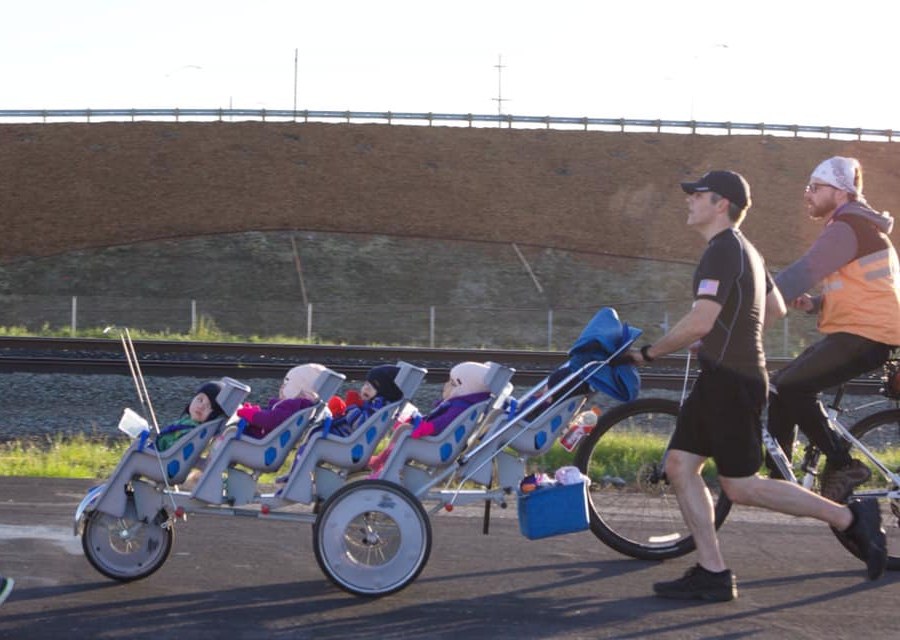
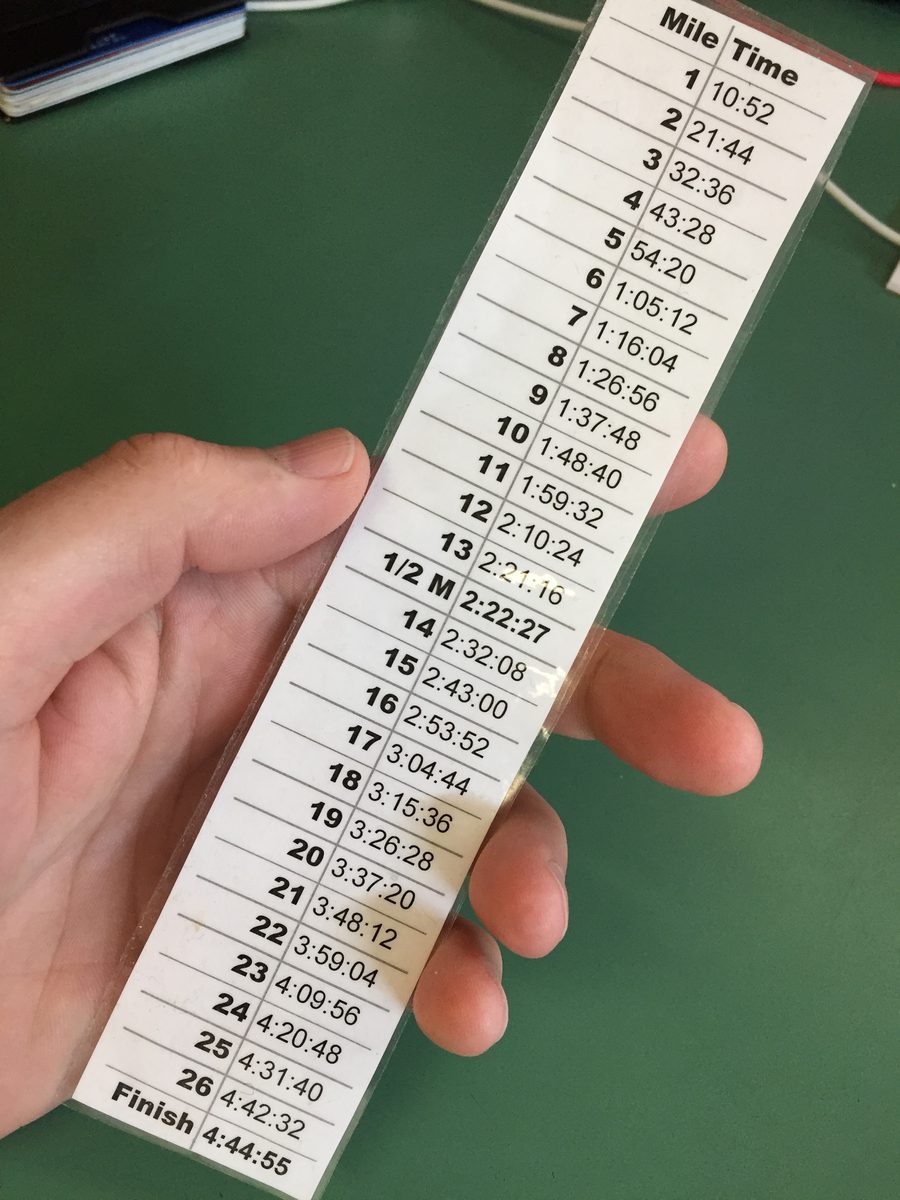
Mile 20 was where it got ugly. That's where a marathon gets honest with you anyway, and I still had Oakland sitting in my quads.
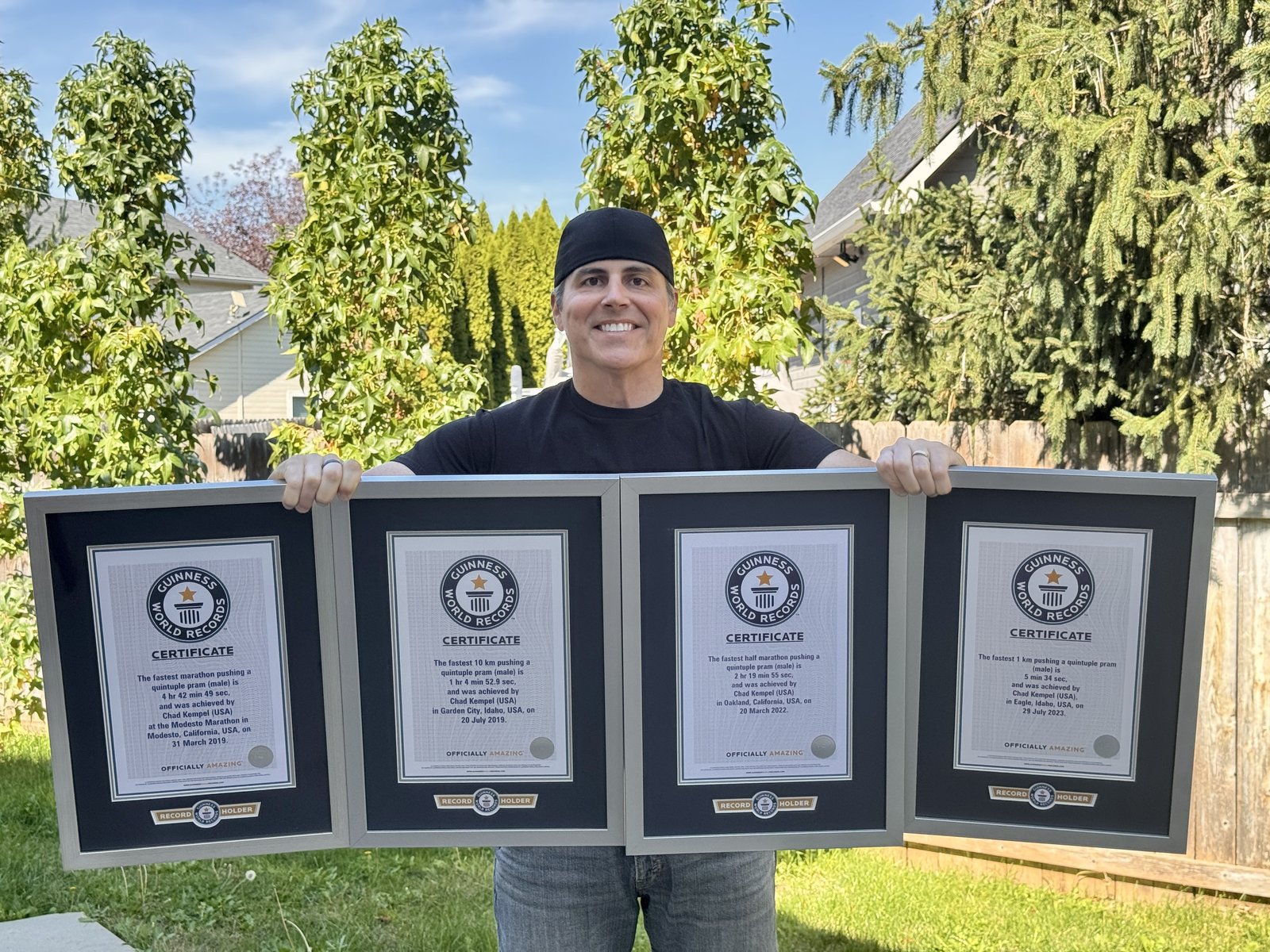
I crossed in 4:42:49, two minutes and eleven seconds under. That was the record.
People see the certificate. They don't see the two finish times that came before it. 5:31:32 and 4:49:29 are the whole reason there's a certificate at all.
Why does almost hurt more than missing by a mile?
In 1995, three Cornell psychologists, Victoria Medvec, Scott Madey, and Thomas Gilovich, went through footage from the 1992 Summer Olympics and found something that sounds backwards. Bronze medalists looked happier than silver medalists, both right after their events and up on the podium.
Silver beat them. So why the long faces?
It comes down to what each athlete compares themselves to. The silver medalist can't stop thinking about the gold that almost happened, while the bronze medalist is thinking about how close they came to going home with nothing. Psychologists call that counterfactual thinking, the "what might have been" loop your brain keeps running after something's over.
Ten years later, Peter McGraw, Barbara Mellers, and Philip Tetlock added a twist. A lot of it comes down to expectations. Silver medalists tend to take it harder because they showed up expecting more.
Surf City was a clear miss. Oakland was my silver medal. I didn't just want that one. I expected it.
Can a near miss actually help you?
A team led by Eric Allen dug through almost 10 million marathon finishing times and found runners piling up right under round numbers like four hours. People plan their races around those numbers, and when they're close near the end, they dig in and push.
Their study is about round numbers, not second chances, but the lesson carries over. A clear number gives your effort something to push against. "Run a good marathon" gives you nothing. 4:45 gave me a target, and Oakland told me exactly how far off I was. Ten seconds a mile is a problem you can actually work on.
The sting of almost and the push at the end come from the same place, your brain staring at the thing you nearly had. It can keep you stuck. It can also make you faster.
Try this
Within an hour: write down exactly how short you fell, as a number instead of a feeling. "I bombed the test" turns into "I missed a B by six points," and you can actually do something with the second one. Then put the paper away. The number's for tomorrow, not for staring at all night.
That night: split the miss in two. What was the course, and what was you? You can train for some of it. The rest, like my hills, just means picking a different race.
Before you go to sleep: pick your next try and put a date on it. I had the next marathon pulled up before we even hit the freeway. Wait too long and it gets way too easy to talk yourself out of going again.
And if there's no next race: sometimes there isn't. You got cut, the school said no, the season's over. Then the next try is a different goal, and that counts too.
So you fell short. Fine. Now you know by how much, and that's the number you go after next.
Why You Freeze Under Pressure, and How to Snap Out of It →
More from Insights
Sources
- Medvec, V. H., Madey, S. F., & Gilovich, T. (1995). When less is more: Counterfactual thinking and satisfaction among Olympic medalists. Journal of Personality and Social Psychology, 69(4), 603–610.
- McGraw, A. P., Mellers, B. A., & Tetlock, P. E. (2005). Expectations and emotions of Olympic athletes. Journal of Experimental Social Psychology, 41(4), 438–446.
- Allen, E. J., Dechow, P. M., Pope, D. G., & Wu, G. (2017). Reference-dependent preferences: Evidence from marathon runners. Management Science, 63(6), 1657–1672.
From Insights by Chad Kempel. Read it online at chadkempel.com/insights/after-you-fail/
Get the free 10-principle guide.
Subscribe and get Anything Is Possible Was Never the End of the Sentence: 10 principles pulled from real moments, for anyone still figuring it out. Then one email when a new Insights article goes up. Unsubscribe anytime.
Just want the guide? It’s $1, no email needed.