What should you do when someone says your goal is a bad idea?
Keep the warning and question the verdict. Ask whether the person knows the thing you want to do, then turn every risk they name into something you prepare for. Research on mental contrasting backs this up: picturing the obstacles along with the goal helps people follow through. And if an expert tells you to stop right now, you stop.
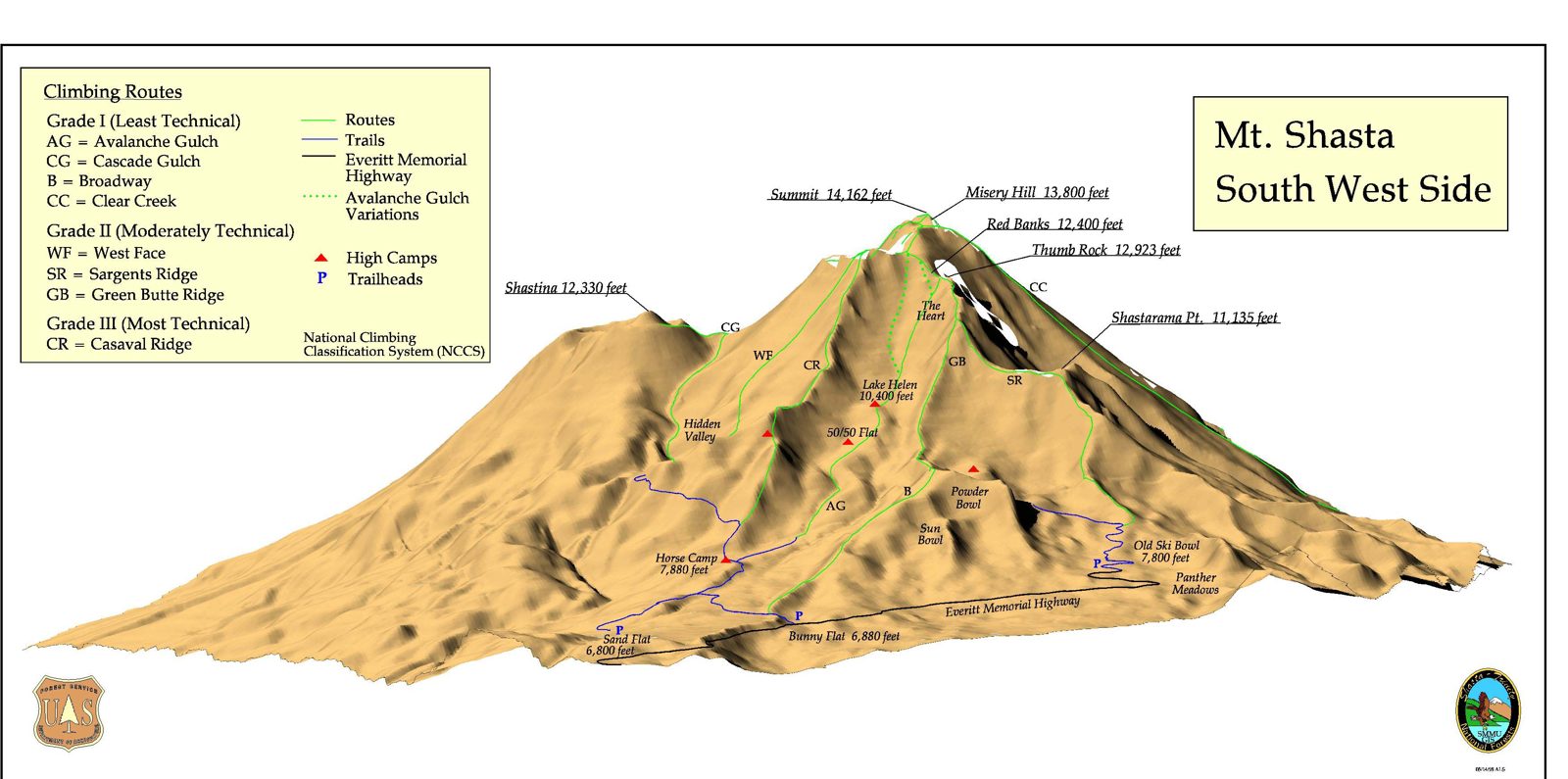
Before I climbed Mt. Shasta, someone I knew who had climbed it sent me a long email. One line stuck with me: "This isn't a hike." The Forest Service made the same point this June, calling the mountain "a high-altitude mountaineering environment, not a hike."
What experience did I have? Would I recognize altitude sickness? Did I know how to use an ice axe? What was my plan if a storm caught me up there? (I didn't have great answers.) She said people die on that mountain every year. She said that for her the trip would be fun and free, and she still wouldn't go.
She wasn't the only one. When I told people my plan, adults told me I needed to train first. They were probably right about that. A couple of my friends told me to my face that I was going to die up there. I don't think they really believed it. I think they were picturing themselves on that mountain.
You can see Mt. Shasta for miles when you drive anywhere near it. In college I heard a classmate mention that people hike to the top. I looked into it and decided I had to do it. It didn't happen on the first try. A couple of plans with my friend Jeff Crinklaw fell apart, so I started emailing people to recruit a group. In the end, it was still just the two of us.
Was the warning right?
About a lot of it, yes.
At 10:15 a.m. on June 30, 2012, I put on my backpack at the trailhead for the first time since packing it. It weighed about 60 pounds. The heaviest pack I'd carried before that was maybe 20. I laughed and told Jeff I didn't know how I was going to get it up there. He said, "Let's go," and started walking.
I had the straps wrong, so the weight sat on my shoulders instead of my hips until Jeff fixed it. We packed too much gear and not enough water. At camp it took about 30 minutes just to melt enough snow to boil.
Jeff and I spent most of that first day asking each other, "You wanna quit?" Neither of us meant it. That's just what I do when I'm that miserable.
We also got lucky, because the weather was perfect. On the way up we met two climbers who had turned back because of a whiteout near the top. One of them said you can't always summit, and that's okay. I remember thinking I would have kept going. That would have been a dumb decision, and I'm glad I never had to make it.
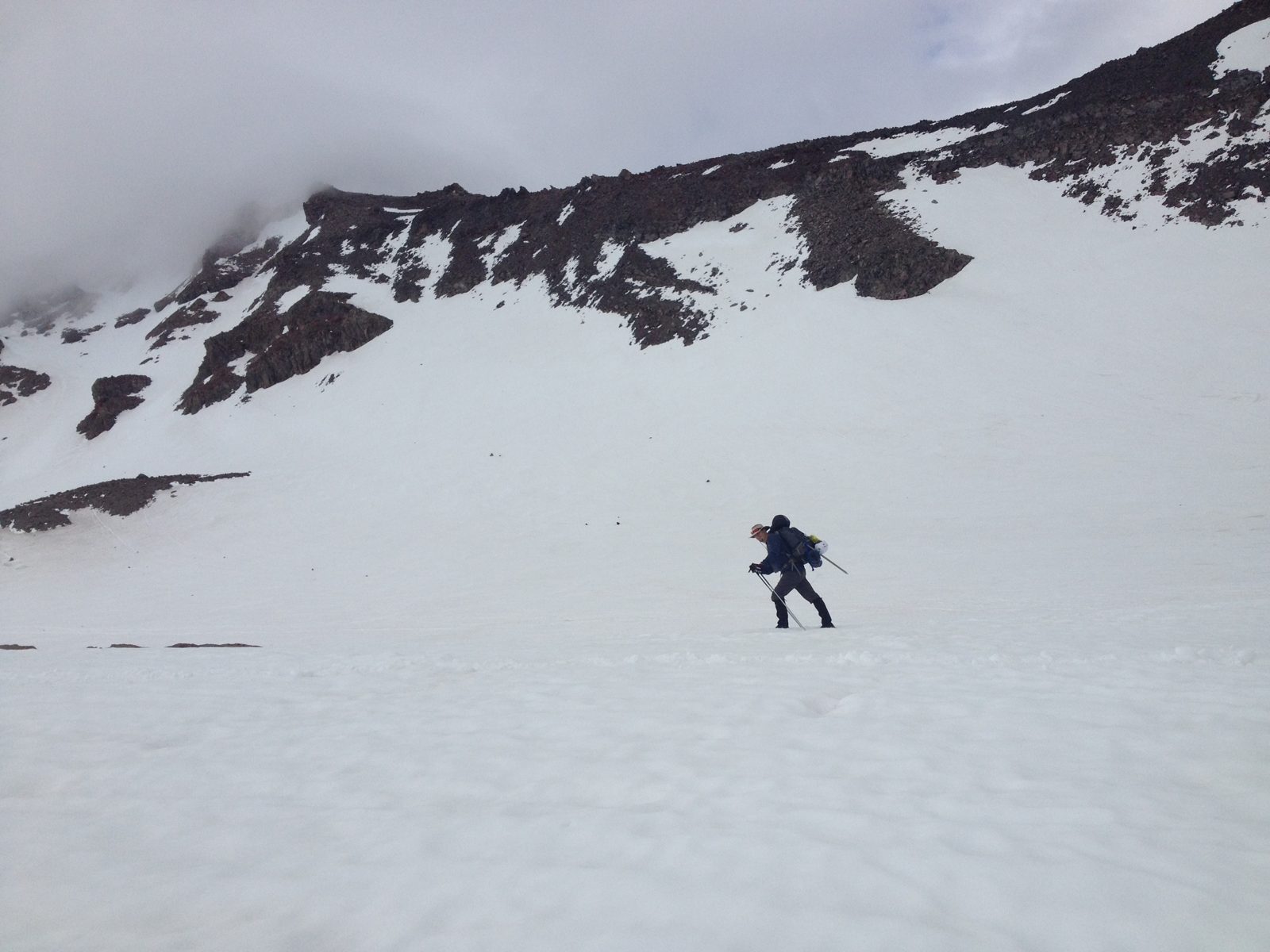
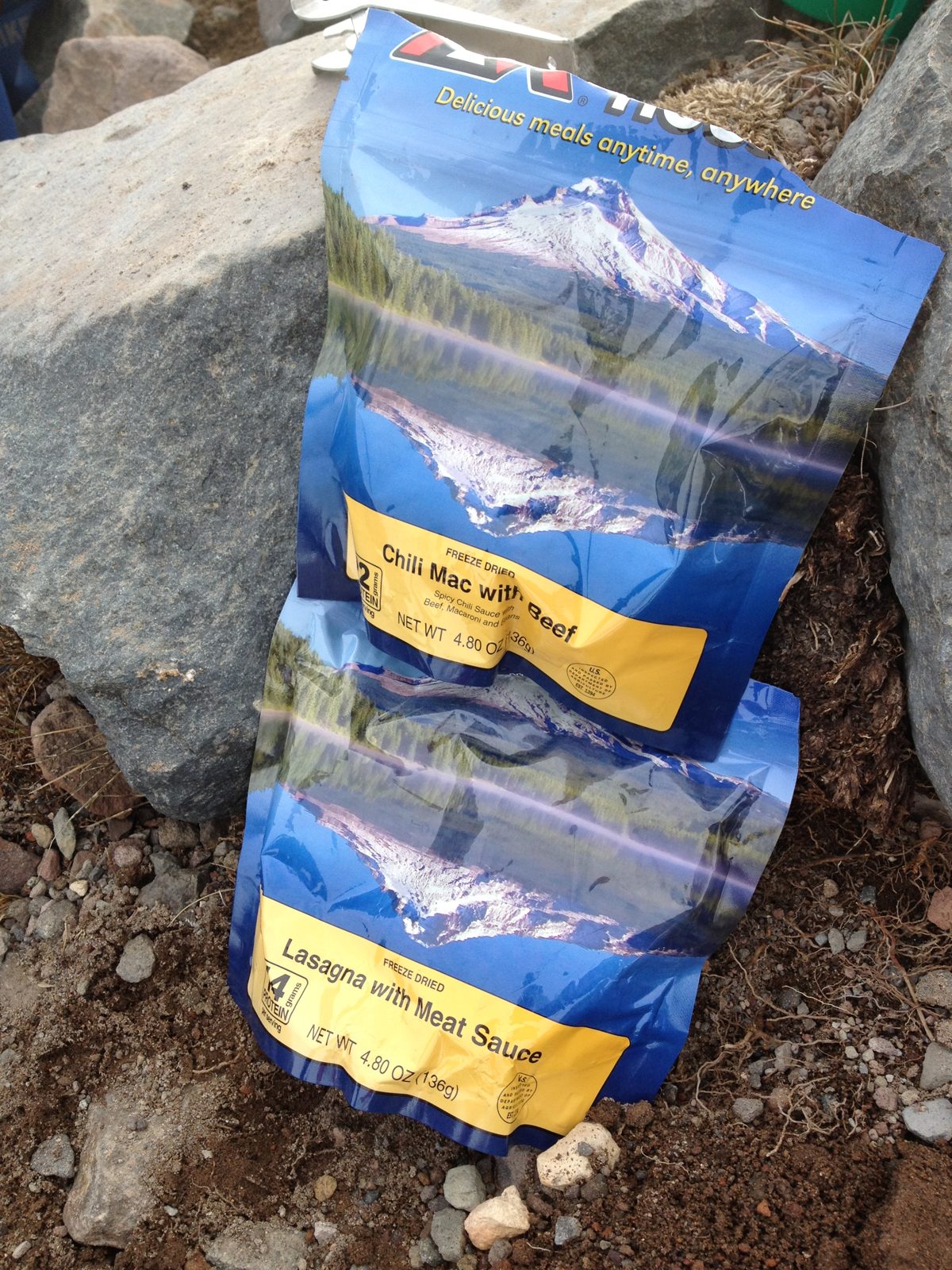
We reached Helen Lake, our camp at about 10,400 feet, at 4:46 p.m., six and a half hours after we started. I couldn't catch my breath, and dinner was freeze-dried lasagna that came out a little crunchy, which didn't matter because we were hungry.
Why didn't we turn around?
Then the joking stopped. Over dinner we started talking, for real this time, about going back down in the morning. We were sore, low on water, and tired of waiting on snow to melt. We knew what to do differently next time. I think each of us was hoping the other would be the one to say it.
Neither of us did. We climbed into our tents at 8 p.m., while it was still light, and set an alarm for 3:30. We never said out loud which way we were going. The alarm said it for us. I barely slept anyway. My tent was on a slant and I spent the night sliding toward my feet.
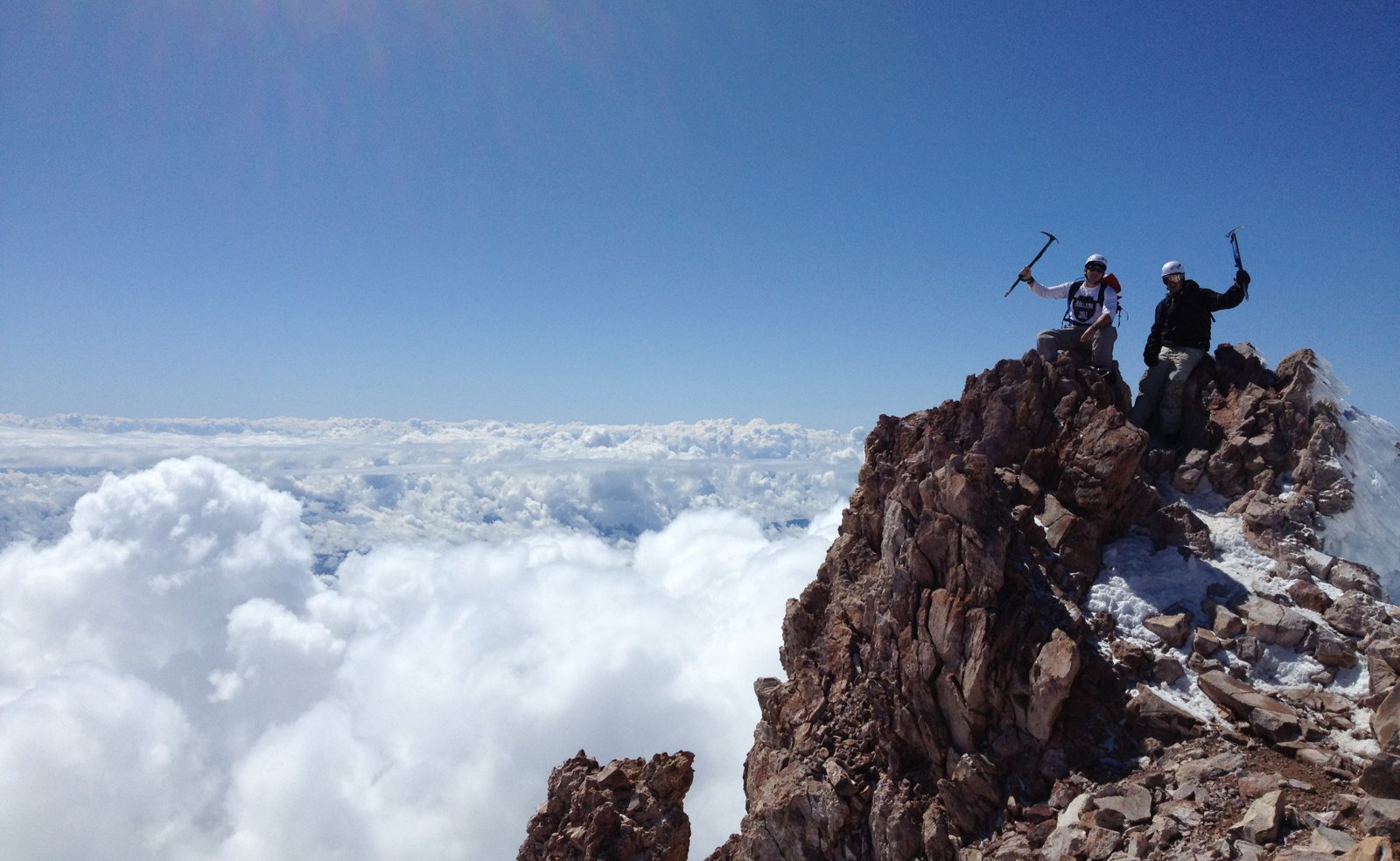
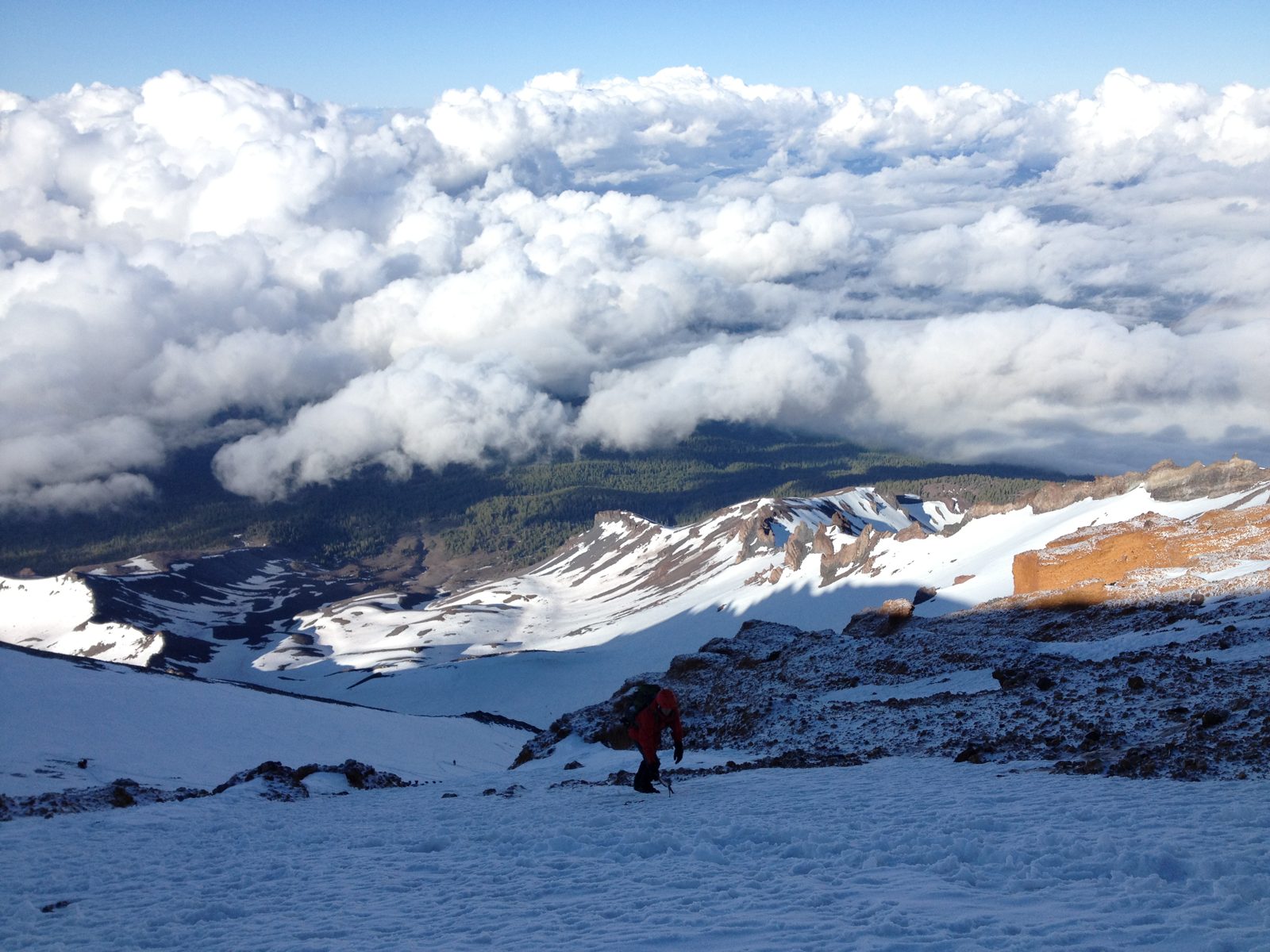
At 4:05 a.m. we left camp by headlamp. At 10:25 a.m., six hours and 20 minutes later, we stood on the summit at 14,179 feet and looked down on the clouds. I signed the summit register with three words: Anything is possible.
We were two untrained guys who packed wrong and caught perfect weather. I'm proud of that day. I don't recommend doing it the way we did.
Which warnings should you listen to?
The way down taught me the most. To descend fast, climbers glissade, which means sliding down the snow on your backside. The email I got before the trip had asked whether I knew how. Jeff and I were flying. Then a ranger started yelling at us to stop. We stopped immediately, because if we had kept going we would have slid right off a cliff. The Forest Service says safe glissading needs a gentle slope and a clear run-out. A cliff is the opposite of a run-out.
So that trip handed me two very different warnings. The email was a prediction about me. The ranger was telling me about the slope in front of my feet. I argued with the first one for months. I obeyed the second one in about half a second.
Most warnings land somewhere in between. That email had real information in it: altitude, storms, gear, timing, skills. It also had a verdict: she wouldn't do it herself, though she never told me not to. A lot of what we did matched her advice. We went in early July, spent the night at Helen Lake, and started for the summit in the dark. I just didn't take her verdict.
What does the research say about doubt and goals?
Psychologist Gabriele Oettingen has spent decades studying how people chase goals. In one set of studies, the people who daydreamed most about a great outcome did worse at finding jobs, on exams, and recovering from hip surgery. The fantasy felt so good they didn't push as hard.
Her fix is called mental contrasting. You picture the goal, then you picture the main thing standing in your way. In one study, 66 high school sophomores preparing for the PSAT did a 30-minute written version of this exercise and made if-then plans for their obstacles. They completed more than 60 percent more practice questions than students who did a different writing exercise.
A 2021 review of 21 studies and nearly 16,000 people found that mental contrasting paired with if-then plans helps people reach their goals, with a small to moderate effect that publication bias may have inflated. Oettingen's earlier experiments found that the method cuts both ways. When people's chances of success looked good, picturing the obstacles made them commit harder. When their chances looked poor, they committed less. So it doesn't push you toward every goal. It also shows you which ones to drop.
I didn't see it this way in 2012, but that email did the exercise for me. It made me look at every obstacle. Then I had to decide if I could handle them.
Try this
Ask if they know the thing. Someone who has climbed the mountain, played the sport, or taken the class knows things you don't. Someone repeating a fear they heard doesn't.
Split the risk from the verdict. "The weather up there changes fast in the afternoon" is information. "You can't do that" is a verdict. Keep the information and question the verdict.
Write down every risk they named. Next to each one, write what you'll do about it. If you can't answer one, that's your next step, or your sign to wait.
If it's your parent saying no, that's a different conversation. Ask what it would take to change their mind, then go do that.
If an expert says stop right now, stop. You can argue about it afterward.
How can teachers use this?
The high school study took 30 minutes and a pen. Students name a goal, the best outcome, the biggest obstacle inside themselves, and an if-then plan for it. Oettingen's free version is called WOOP, for Wish, Outcome, Obstacle, Plan. It fits in an advisory period, a goal-setting unit, or the week before tryouts. It's also the idea behind my all-school assembly.
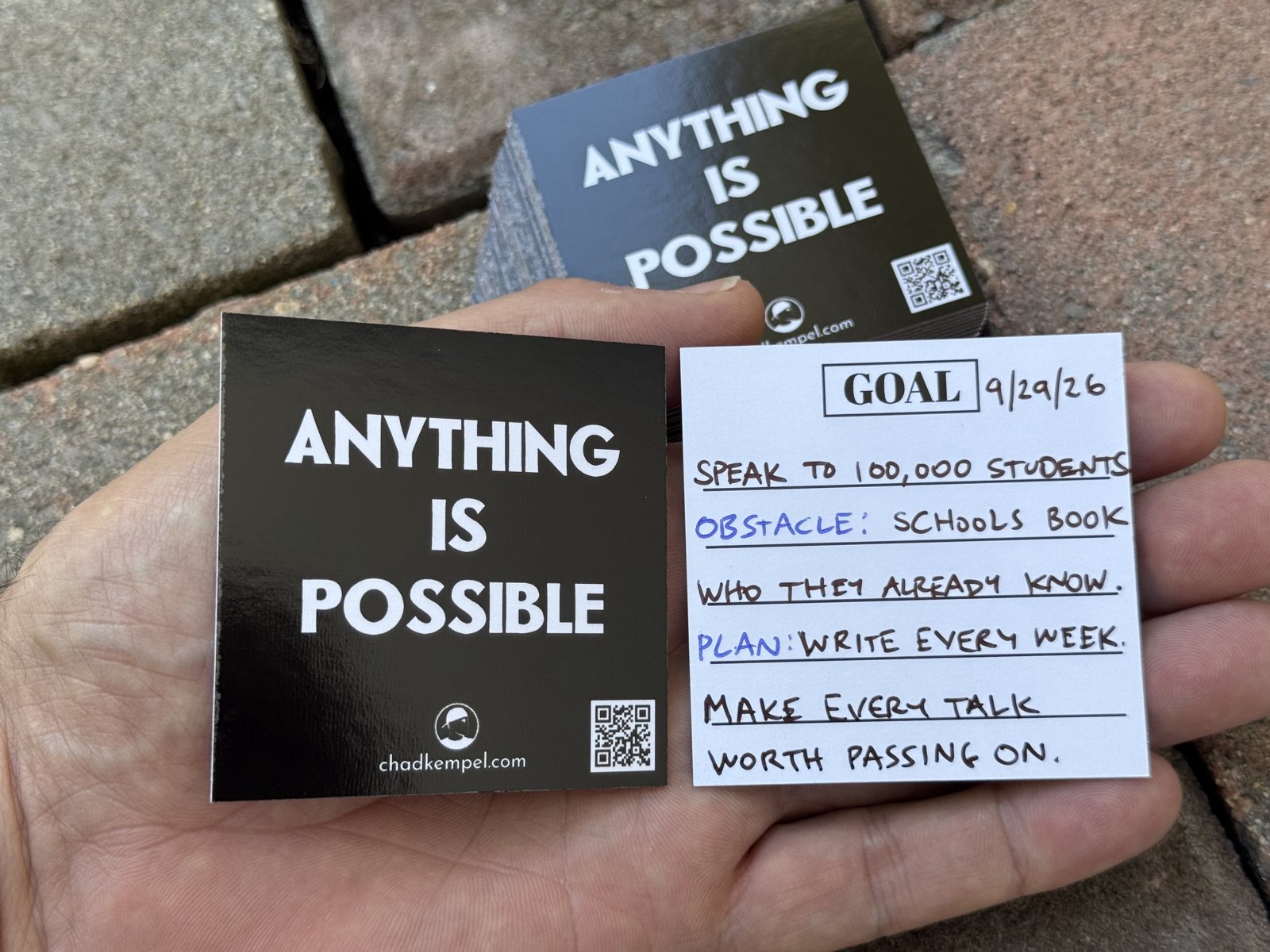
I'm handing out goal cards at every talk I give. One side says Anything Is Possible. The other says GOAL, with blank lines under it. Put the goal on the first line. Use the rest for the thing most likely to stop you and what you'll do when it shows up. Then keep it somewhere you'll see it. The front is the same phrase I once printed on a sign for an Ironman, and that story is in My Father, Nuclear Fusion, and Anything Is Possible.
What happens after you prove someone wrong?
When I got home, I posted a summit photo. I didn't send it to anyone who had said I'd die up there, and none of them said anything about it. People are loud when they tell you not to do something. When you do it anyway, it gets really quiet.
I'm not mad about it. All of those people are still my friends. What I hope is that watching someone they know do it makes their own goal feel possible. That's how it worked for me. I didn't know people climbed Shasta until someone mentioned it.
Five years later, I summited Mt. Whitney, the highest peak in the lower 48.
So next time someone tells you your goal is a bad idea, don't just get mad. Write down what they said. Some of it's probably true. Use that part.
What to Do the Day After You Fail →
More from Insights
Sources
- Oettingen, G., & Mayer, D. (2002). The motivating function of thinking about the future: Expectations versus fantasies. Journal of Personality and Social Psychology, 83(5), 1198–1212.
- Oettingen, G., Pak, H., & Schnetter, K. (2001). Self-regulation of goal setting: Turning free fantasies about the future into binding goals. Journal of Personality and Social Psychology, 80(5), 736–753.
- Duckworth, A. L., Grant, H., Loew, B., Oettingen, G., & Gollwitzer, P. M. (2011). Self-regulation strategies improve self-discipline in adolescents: Benefits of mental contrasting and implementation intentions. Educational Psychology, 31(1), 17–26.
- Wang, G., Wang, Y., & Gai, X. (2021). A meta-analysis of the effects of mental contrasting with implementation intentions on goal attainment. Frontiers in Psychology, 12, 565202.
- WOOP (Wish, Outcome, Obstacle, Plan). Free tools and instructions from Gabriele Oettingen.
- ABC7 News (June 2026). Woman rescued after surviving 1,500-foot drop during Mt. Shasta climb. Includes the U.S. Forest Service statement that Mount Shasta is a high-altitude mountaineering environment, not a hike.
- Teton Gravity Research (August 2025). Solo climber seriously injured in 300-foot fall on Mount Shasta. Quotes the U.S. Forest Service's glissading guidance.
From Insights by Chad Kempel. Read it online at chadkempel.com/insights/when-people-doubt-your-goal/
Get the free 10-principle guide.
Subscribe and get Anything Is Possible Was Never the End of the Sentence: 10 principles pulled from real moments, for anyone still figuring it out. Then one email when a new Insights article goes up. Unsubscribe anytime.
Just want the guide? It’s $1, no email needed.