Does fighting back stop a bully?
Not the way The Karate Kid tells it. Bullies pick kids they expect nobody will stick up for, so the fastest way off that list is to stop being the kid standing alone, not to win a fight. Join something with people in it. Tell an adult, even after it's over. Wanting to hit back is normal. Revenge usually keeps it going.
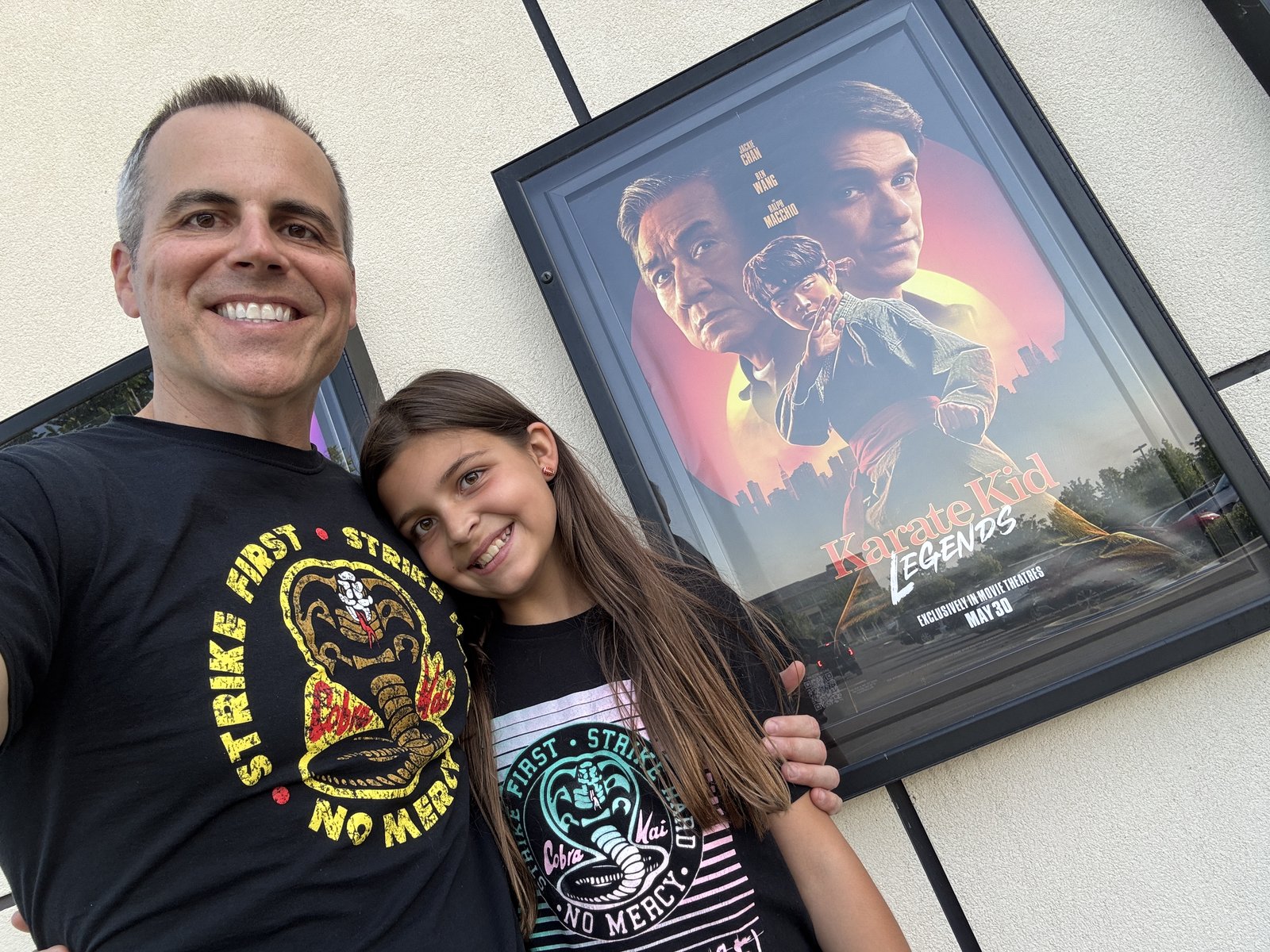
The Karate Kid came out in 1984. I was two. I saw all three of the originals for the first time in the eighties and I've watched them plenty of times since. My brothers and I did the crane kick pose in the living room more than once. Now I've watched every one of them with my seven kids. The youngest ones aren't ready for Cobra Kai yet, but my oldest and I watched it together. By the time I was standing at my gym locker in eighth grade, every boy in America knew how that story was supposed to end. You get pushed around. You find your Mr. Miyagi. You train. And then, in front of everybody, you put the kid who did it on the mat.
I got the first part.
Eighth grade, getting ready for PE. Out of nowhere, a full open palm across the side of my face. Not fingers. The whole hand, as hard as I've ever been hit, before or since. I looked over. He had about a foot on me and he was built. He lunged at my face, stopped an inch short, and said, "What?!" The locker room was full. Everybody saw it. Nobody said a word, then or ever.
For about one second I was going to hit him back. I wanted it more than I've wanted most things. Then the math finished running: he was bigger, he was stronger, and I'd end up on the floor. So I stood there and looked him in the eye and wished it would be over. He walked away. I didn't tell my parents until I was in my thirties.
Every kid who's been hit like that writes the crane kick ending in his head. I wrote it a hundred times.
What does the movie promise?
Daniel LaRusso moves to California, gets beaten up by a pack of karate students, and finds an old handyman who teaches him to fight by making him wax cars and paint fences. A few months later he wins the All Valley tournament on one good leg, with a kick to the face of the kid who tormented him. The bully hands him the trophy and tells him he's all right. Credits.
I love the movie. But look at what it tells a fourteen-year-old who just got hit: your problem is that you can't fight, and the fix is winning. Train hard enough and you'll get your tournament.
Thirty-four years later Cobra Kai picked the story back up, and it turns out the ending didn't stick. Johnny never got over losing. Daniel never got over Johnny. Two men in their fifties, with jobs and kids, spent the first few seasons re-fighting a high school karate tournament and pulling a new set of teenagers into it. Mr. Miyagi had said the whole time that karate was for defense only. The crane kick is still the only scene anybody remembers.
What actually happened?
No tournament. Nothing that would make a movie.
It happened again the first few weeks of ninth grade. Different kid, same gym. He slammed his hands on both sides of my head and put his face an inch from mine, telling me to do something. I didn't. I just hoped it would be over fast.
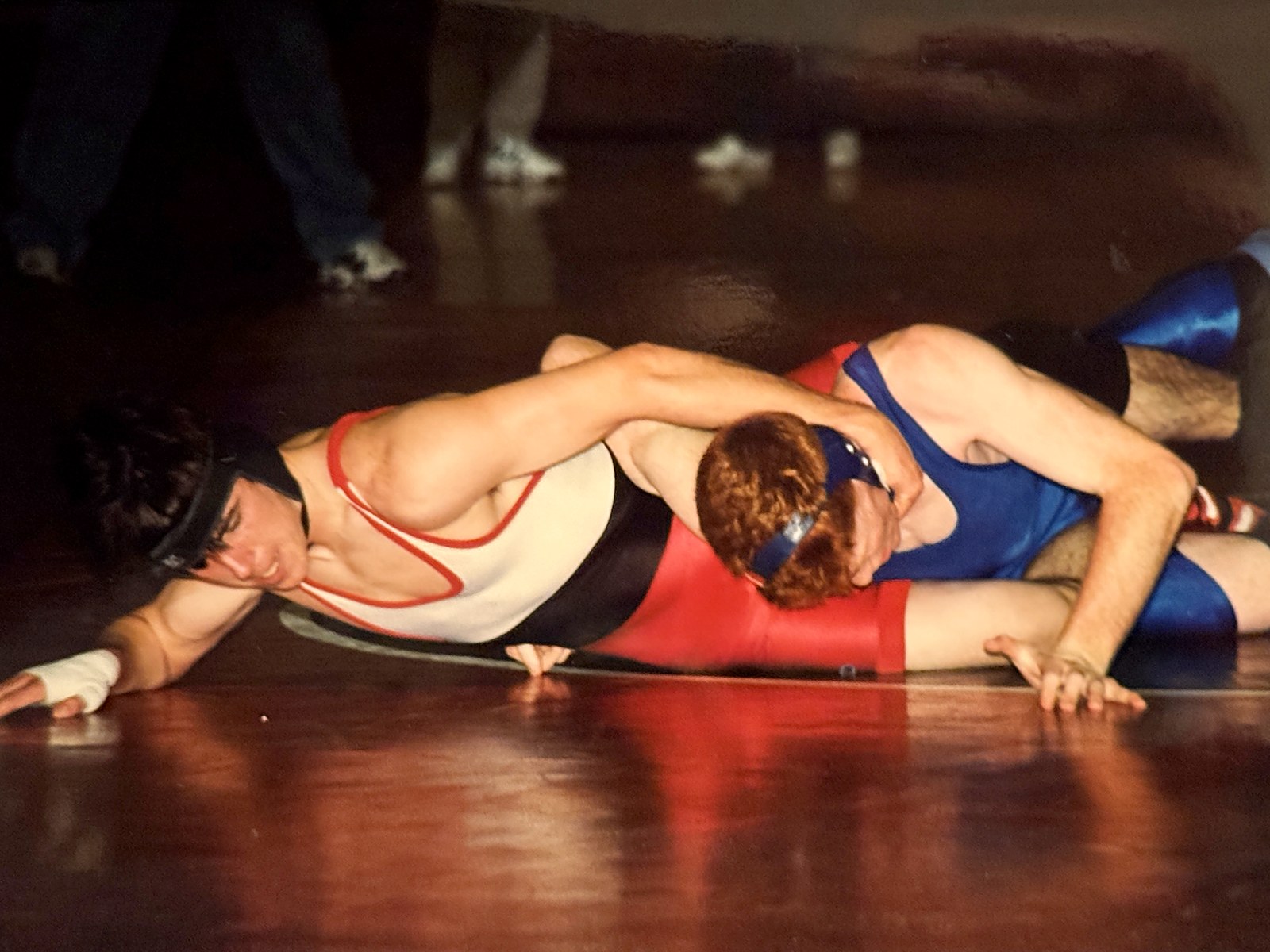
That year I signed up for wrestling at Arroyo High School in San Lorenzo, California. The slap had a lot to do with it. I'd love to say I walked into the wrestling room with a plan. Mostly I didn't want to be the smallest guy in the gym anymore. Four years of it. Cutting weight, running until it stopped feeling like punishment, keeping my grades up because a bad report card meant sitting out. Somewhere in there I got some height and some size. And something else happened that I didn't notice until later. My reputation started walking into rooms before I did.
At a party in high school a kid got in my face. I stood up. I took my sweatshirt off, because I thought it was on. Then he said it: "I know you're swoll. I know you're on the wrestling team." I sat back down with him still standing over me. A minute later he left.
That's it. That's my crane kick. A kid saying one sentence and walking away. I'm in my forties. I've never been in a fight, then or since. Wrestling never won me a fight. It took me off a list.
Why did he pick me?
The movie treats bullying like a fight you lost, which you fix by winning one. I taught psychology at San Jose State University for five years, and the research says it was never a fight. The federal definition of bullying has a power imbalance built right into it. A fair fight isn't bullying. The whole thing only works when one side has already decided the other can't do anything about it.
So who gets decided on? A team in the Netherlands followed almost 500 kids, ages nine to twelve, and asked that exact question. Bullies went after kids who were weak and not well liked by the rest of the class, because those kids rarely got defended. The bully got to dominate somebody in front of an audience without losing any friends over it. He was shopping for a kid nobody would stick up for.
A foot taller than me, in a room full of people who said nothing. I was the right pick.
None of that was on me. A kid doesn't make himself a target. The room does, by leaving him alone in it.
The flip side showed up in a study of early adolescents measured six months apart. Kids with a best friend in their own class got picked on less. Kids with no best friend at either point saw the biggest rise in bullying over the six months. Kids with one at both points saw the biggest drop. One person in your corner moved the number. Both of those studies are younger than your students, so take them as direction, not proof.
A wrestling team is thirty of those. I'm not going to pretend getting bigger didn't help. It did. But a smaller kid with a team around him is a worse target than a bigger kid who eats alone, because the first one isn't alone. That's the part the movie skips. Daniel needed one friend at school a lot more than he needed a trophy.
Why doesn't hitting back close it?
I wanted to hit him. I still remember exactly how much. So I went looking for what happens to people who get the chance.
Psychologists at Colgate, Virginia, and Harvard set up a game where college students could earn a little money, and one player cheated everybody else. Some students got the chance to punish the cheater by taking money away. Others didn't. Everyone assumed punishing would feel good. The people who punished felt worse than the people who couldn't, and afterward they were still stewing about the cheater. Getting even didn't close anything. It kept the other person in their head.
It's a lab study with a few dollars at stake, not a locker room. I'd still bet on it.
That's the first half of Cobra Kai. Johnny got his revenge fantasy, a new dojo and a second shot at the tournament, and it settled nothing. Daniel had a car dealership, a family, and his face on billboards, and he couldn't let Johnny go either. It took the two of them years to quit. By the last season Daniel's in a black Cobra Kai gi, coaching Johnny through the final match. The fighting stopped once they were in the same corner.
And the kid who finally swings often becomes the next problem. Eli gets a mohawk, starts calling himself Hawk, and goes from the kid with the scar everybody mocked to the kid doing the mocking. Every teacher reading this has met him.
Why didn't I tell anyone?
At the time, three reasons.
Telling felt like losing twice. Standing there had already cost me something. Saying it out loud at the dinner table meant admitting it in a second room.
I figured it would get worse. He was in my school every day. A conversation in an office wasn't going to shrink him.
Nobody else said anything, so I decided it wasn't a thing. A room full of people watched and went to PE. If it mattered, somebody would've said so. That's the same logic the bystanders were running, pointed back at me.
The fourth reason is the one nobody plans. Not long after, he stopped showing up at school. Expelled or just done with it, I never found out. Life moved on. He wasn't a threat anymore, so there was nothing left to report. I never decided to keep it quiet for twenty years. It just stopped feeling like a thing that counted.
It counted. I carried anger out of that locker room for years. I also started noticing, fast, when it was happening to somebody else. I'll take that trade. I didn't get to pick it.
Counselors know all four. The last one's the quiet one. The threat leaves, the kid files the story under over, and he goes on carrying it anyway.
Try this
Wanting to hit back is normal. It isn't a plan. The one second where I did the math and stood there was the best decision I made that year, even though it felt like losing.
Get on a different list. Join something with people in it. A team, a club, the lunch table that always has one open seat. It doesn't have to be a fight sport. It has to be people who know your name. A pickup football game on the blacktop did that for me in tenth grade, and I wrote about it in You Don't Need a Best Friend to Belong Somewhere.
Tell an adult, even after it's over. I didn't, because he was gone. The anger wasn't. If it's happening now, tell one today.
If it's happening to somebody else, say one sentence. The bullies in that Dutch study picked kids nobody would defend. One kid saying "knock it off" changes the math more than any kick.
Teachers and administrators: the kid who finally swings may be the original target. Before both kids get the same consequence, find out what came before the swing. A kid who hits back after a semester of this and the kid who started it aren't the same case. Check whether your discipline code treats them that way.
Count the kids with nobody. That's the list the bully is working from. Shorten it and you shorten his options.
How can teachers and counselors use this?
A lot of your students have seen Cobra Kai, and they know Hawk. Ask them who in that story was on the target list and what changed it. A kid who can see that the list is about who's alone can see who's alone in your building. That's what I built my anti-bullying and belonging assembly to do: get a gym full of students to notice the empty seat, and then do something about it before lunch is over. One person. One seat. Tomorrow.
The research word for the kid who says one sentence is a defender. Schools say upstander. Either way, he's the kid the bully needs to be missing. That's the pattern the Dutch study points to.
Fifteen minutes in advisory
Who in Cobra Kai was on the target list, and what moved them off it? Miguel, Eli, Demetri. Let them argue it.
In the locker room story, what's the one sentence somebody could have said? Make them say it out loud. It's shorter than they think.
What's the difference between standing up for yourself and getting even? This is where the revenge study goes.
Who eats alone in this building? Don't say it out loud. Write one name down and sit there Thursday.
If you're the kid at the locker right now, running the math: I know. Let him keep the fight. Go find your people. He's counting on you not having any.
Why You Freeze Under Pressure, and How to Snap Out of It →
More from Insights
Sources
- Veenstra, R., Lindenberg, S., Munniksma, A., & Dijkstra, J. K. (2010). The complex relation between bullying, victimization, acceptance, and rejection: Giving special attention to status, affection, and sex differences. Child Development, 81(2), 480–486.
- Society for Research in Child Development (March 27, 2010). Pursuit of status and affection drives bullies' behavior. Plain-language summary of the Veenstra study.
- Boulton, M. J., Trueman, M., Chau, C., Whitehand, C., & Amatya, K. (1999). Concurrent and longitudinal links between friendship and peer victimization: Implications for befriending interventions. Journal of Adolescence, 22(4), 461–466.
- Carlsmith, K. M., Wilson, T. D., & Gilbert, D. T. (2008). The paradoxical consequences of revenge. Journal of Personality and Social Psychology, 95(6), 1316–1324.
- Association for Psychological Science. The complicated psychology of revenge. Plain-language summary of the Carlsmith study.
- StopBullying.gov (U.S. Department of Health and Human Services). What is bullying? The definition, including the power imbalance.
From Insights by Chad Kempel. Read it online at chadkempel.com/insights/karate-kid-bullying/
Get the free 10-principle guide.
Subscribe and get Anything Is Possible Was Never the End of the Sentence: 10 principles pulled from real moments, for anyone still figuring it out. Then one email when a new Insights article goes up. Unsubscribe anytime.
Just want the guide? It’s $1, no email needed.