Are people really as bad as they seem online?
No. In study after study, ordinary people turn out to be more honest and less hostile than we expect. The ugly picture most of us carry around comes from a small, loud slice of people who post far more than everyone else. Once you know that, it gets a lot easier to give the person in front of you a fair shot.
We've all put the phone down after twenty minutes of scrolling and felt like the world has lost its mind. Then we walk into a grocery store, and a stranger holds the door, the cashier asks how our day is going and actually waits for the answer, and somebody in the parking lot waves us into the spot they were about to take. Those two worlds can't both be the real one. When researchers have gone looking for which one is, the grocery store keeps winning.
What do people do when nobody's watching?
A team of economists ran one of the largest honesty tests ever attempted. Over three years they turned in more than 17,000 "lost" wallets at banks, hotels, post offices and police stations in 355 cities across 40 countries. A research assistant handed each one to whoever was working the counter, said they were in a hurry, and left. Each wallet held a few business cards with an email address, a grocery list, and usually a key, and some of them held cash. Then the researchers waited to see whether that employee would contact the owner.
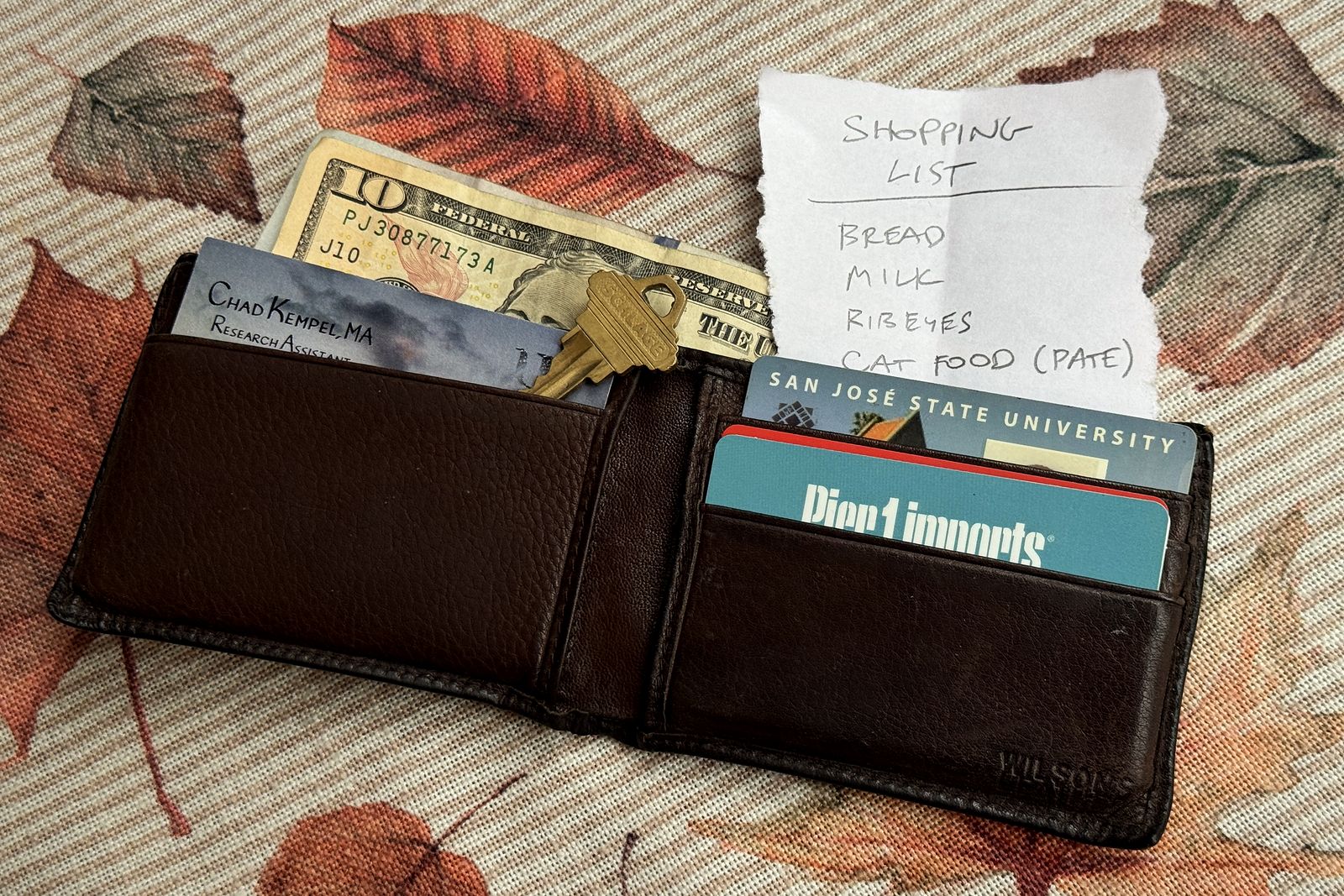
Most of us would guess that the more money inside, the fewer wallets come back. That's what people predicted when the researchers asked them, and a panel of professional economists expected roughly the same thing, only less steeply. Neither saw the rise coming. With no money inside, 40 percent of the wallets were reported to their owners. With about $13 inside, 51 percent. In the three countries where the researchers also tried about $94, the rate climbed from 46 percent with no money to 72 percent with the big bills. In 38 of the 40 countries, more money meant more honesty, not less.
The researchers' explanation is simple, and it's a decent description of most people you'll ever meet. They cared about the stranger who'd lost something, and they didn't want to become the kind of person who keeps it.
So why does everyone seem so awful?
Spend enough time on almost any app and you'd come away convinced that half the country is cruel and the other half is lying. A study published in 2025 put that impression to the test. Across three studies with about 1,100 Americans in all, researchers asked people to guess how many Reddit users had posted severely toxic comments. The average guess was 43 percent. Platform data puts the real number closer to 3 percent.
People weren't wrong about how much ugly content they were seeing. They were wrong about who was writing it. A small group of very active accounts produces a huge share of it, and our brains spread the blame across everybody. Outrage gets attention, attention gets rewarded, and whatever gets shown over and over starts to feel like everyone. That's the lie, and nobody even had to tell it. Cruel people are real. The lie is that they outnumber the rest of us.
That mistake isn't harmless. In the same paper, people who believed harmful users were common felt worse, saw the country as more morally broken, and got a warped sense of what other people actually want to see. When they were shown the real numbers, those effects shrank.
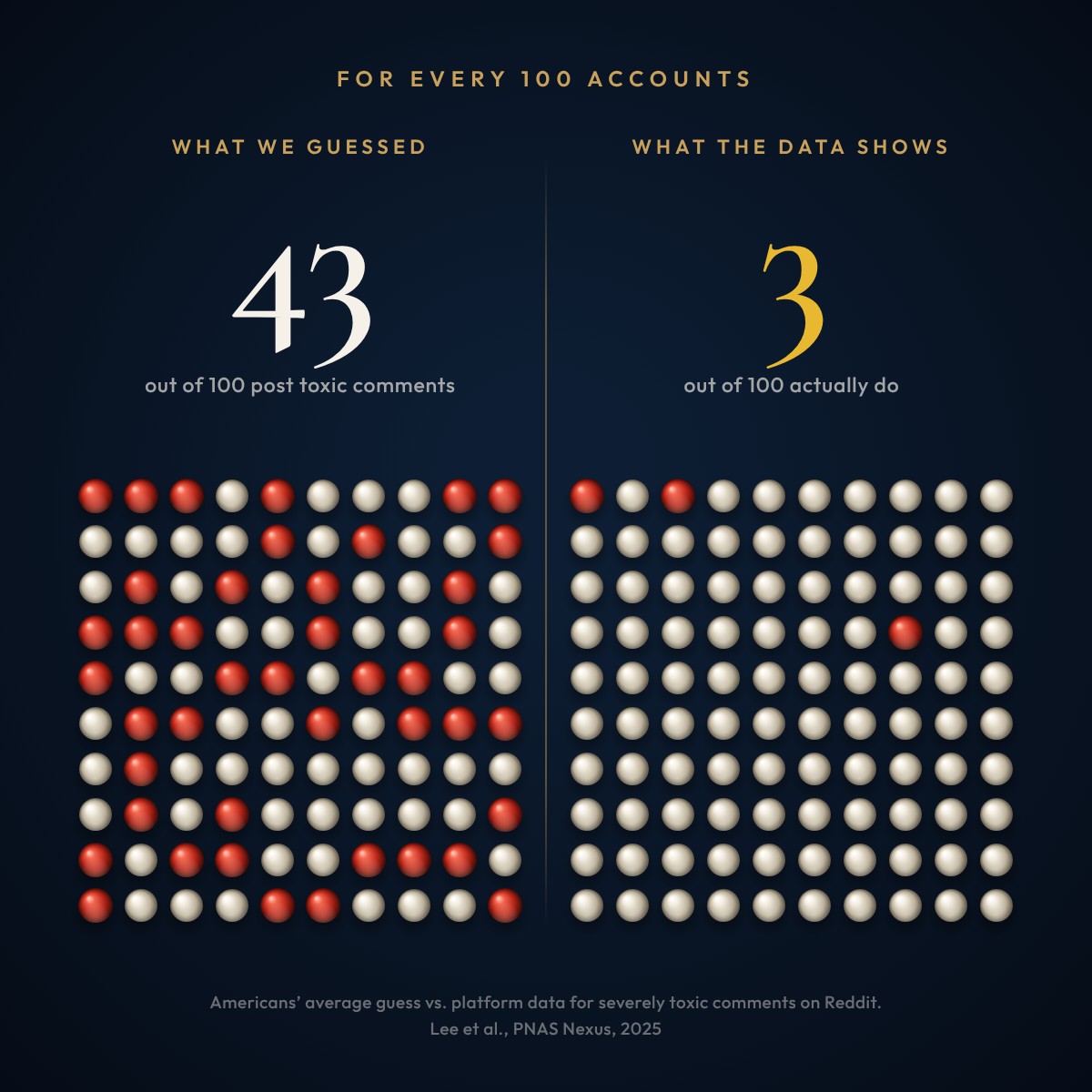
The loudest 3 percent have been painting our picture of the other 97.
Do the people we disagree with really hate us?
Politics is where this has been measured most carefully. When researchers asked Americans on opposite sides of the political divide how the other side saw them, both sides guessed far worse than the truth. Across two studies, including a nationally representative sample, both sides assumed the other side's dislike and dehumanization of them were 50 to 300 percent higher than they really were. The bigger the exaggeration, the more hostile people felt in return.
That runs in both directions at once. They think you think worse of them than you do, and you're making the same mistake about them. Both sides brace for a fight the other side mostly isn't looking for, and the bracing is what starts it.
There's something a feed can't show you. What a person thinks and how that person treats you are two different measurements, and a screen only takes one of them. Plenty of people would disagree with you about nearly everything and are still the stranger who jumps your car, the neighbor who shovels your walk, and the friend who shows up at the hospital without being asked. Most people's kindness happens in person. That kind of decency just doesn't trend.
What does this have to do with school?
Almost everything. Researchers surveyed thousands of middle school students in five New Jersey schools and found they believed bullying was far more common, and far more accepted, than it really was. Most students weren't bullying anyone, yet they guessed it was three to four times as common as it was. The students who believed bullying was normal were also more likely to do it themselves.
Then the schools put up posters showing the real numbers: most students don't bully, and most don't approve of it. Students' picture of their classmates shifted, bullying went down, and the drop was largest where students remembered seeing the posters. No control group, so call it a strong hint rather than proof. Still, nobody gave a lecture on kindness. They just told the truth about what most kids were already like. If you run a school, that's one of the cheapest things on this page: ask your own students, then put their real numbers on the wall.
It's the same mistake in a smaller room. When you're sure the table you're nervous about would rather you didn't sit down, when you've written off the kid whose family sees the world differently than yours, when you walk into class convinced everyone is judging you, you're making the wallet bet. The odds say most of those people are decent, and a lot of them are guessing the same thing about you.
What happens if you expect the worst?
You usually get there first. If you walk into a room expecting people to be cold, you keep your head down, skip the hello, and read every quiet face as a verdict. People notice and keep their distance, which looks like proof that you were right all along. Guarded people make guarded rooms. Researchers showed this in a lab in the 1980s: people told that a stranger didn't like them acted colder in the conversation that followed, and by the end, the stranger liked them less.
I've seen the other side of this too. A few years ago I sat down with a group I was sure had a seat for me, and I found out the hard way it didn't. That one hurt, but it didn't change the math. Most of the tables I've walked up to since have had room. Some people have earned their guard. The point is the other 97.
The person you'd expect to walk right past you is very often the one who stops. People have been told for a few thousand years to expect the best of each other. It was good advice the whole time. It also happens to be the accurate read.
I'd rather hear your story than guess it. The seat next to me is always open.
Try this
Run your own wallet test this week. Pick one person, or one group, you've quietly filed as "not my people." Don't guess what they think of you. Ask them something real: what they're into, how their weekend went, what they thought of something you both just sat through.
Ask instead of imagining. In 25 experiments, people who were told to picture another person's point of view didn't get any better at reading that person, and sometimes got worse while feeling more sure of themselves. What worked was asking.
Then check the data. Pay attention to whether it holds. Most of the wallets with money in them came back.
Fifteen minutes in advisory
What percent of students here do you think have bullied someone this year? Have them guess before you show anything. If your school has its own survey data, share it after.
Where does your picture of what people your age are like come from? How much of it comes from a screen?
Think of someone you were wrong about. What changed your mind?
What's one question you could ask someone this week instead of guessing what they think?
Bullies Don't Pick Fights. They Pick Targets. →
More from Insights
Sources
- Cohn, A., Maréchal, M. A., Tannenbaum, D., & Zünd, C. L. (2019). Civic honesty around the globe. Science, 365(6448), 70–73.
- University of Michigan School of Information (June 20, 2019). Moral concerns override desire to profit from finding a lost wallet. Plain-language summary of the Cohn study.
- Lee, A. Y., et al. (2025). Americans overestimate how many social media users post harmful content. PNAS Nexus.
- Moore-Berg, S. L., Ankori-Karlinsky, L., Hameiri, B., & Bruneau, E. (2020). Exaggerated meta-perceptions predict intergroup hostility between American political partisans. PNAS, 117(26), 14864–14872.
- Perkins, H. W., Craig, D. W., & Perkins, J. M. (2011). Using social norms to reduce bullying: A research intervention among adolescents in five middle schools. Group Processes & Intergroup Relations, 14(5), 703–722.
- Curtis, R. C., & Miller, K. (1986). Believing another likes or dislikes you: Behaviors making the beliefs come true. Journal of Personality and Social Psychology, 51, 284–290.
- Eyal, T., Steffel, M., & Epley, N. (2018). Perspective mistaking: Accurately understanding the mind of another requires getting perspective, not taking perspective. Journal of Personality and Social Psychology, 114(4), 547–571. Plain-language essay by Epley at NPR.
From Insights by Chad Kempel. Read it online at chadkempel.com/insights/lied-to-about-other-people/
Get the free 10-principle guide.
Subscribe and get Anything Is Possible Was Never the End of the Sentence: 10 principles pulled from real moments, for anyone still figuring it out. Then one email when a new Insights article goes up. Unsubscribe anytime.
Just want the guide? It’s $1, no email needed.