 Chad Kempel
Book Chad
Chad Kempel
Book Chad
Chad Kempel
Book Chad
Chad Kempel
Book Chad
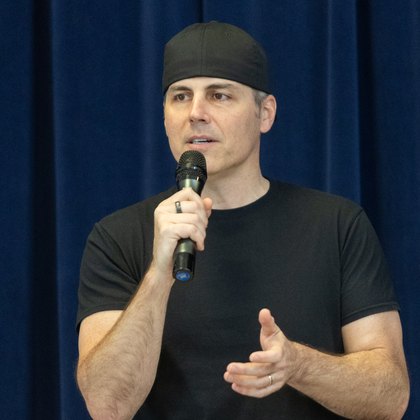
Chad Kempel’s goal-setting assembly for high schools is Anything Is Possible, the talk behind his four Guinness World Records, booked for the start of a semester. Students hear how a ninth grader who couldn’t do one pull-up stacked small wins for years, and every one of them gets a goal card to fill out in their next class. Based in Boise, booking nationwide.
Local Introductory Rate: $1,000 per assembly · See what’s included ↓Students have been told to set goals since kindergarten. What nobody shows them is the middle, the stretch between deciding and done where most goals quietly die. That’s the part this talk is about.
Chad was not a runner. In ninth grade he jumped up for the pull-up test, grabbed the bar, and nothing happened. He couldn’t do one. So he hung there, day after day, then half of one, then one, and by the end of the year he could do more than almost anyone in his class. He was the kid who dreaded popcorn reading, so at community college he signed up for a play, then theater classes, then years of rooms that scared him, until he got up at an open mic and finished a three-minute stand-up set. He didn’t get many laughs. He finished it.
The four Guinness World Records came later, after two public failures. None of it was one big moment. It was small wins, stacked, over years. Students hear the whole stack, and then they get a card.
Grade-school PE, four backstops on the field to run around, and Chad couldn’t finish. What he found out, much later, about who was actually watching.
In ninth grade he couldn’t do a single pull-up. A year of hanging on changed that, and students hear where he ended up.
The shy kid who dreaded being called on to read out loud, and the play, the theater classes and the three-minute stand-up set that came after.
His first world record attempt missed the Guinness cutoff by 46 minutes. Before his wife reached the freeway on the drive home, he was already on his phone looking for the next race. The second attempt missed by four and a half minutes. Read the full story: What to Do the Day After You Fail.
An Ironman he finished for his father, carrying a sign he made that said Anything Is Possible. It’s in a museum in Copenhagen now. It’s also the talk’s case for writing a goal down: the sign wasn’t in his head, it was in his hands. Read the full story: My Father, Nuclear Fusion, and Anything Is Possible.
A goal, the thing most likely to get in its way, and what to do when it shows up. Written down in their next class, not on the bleachers.
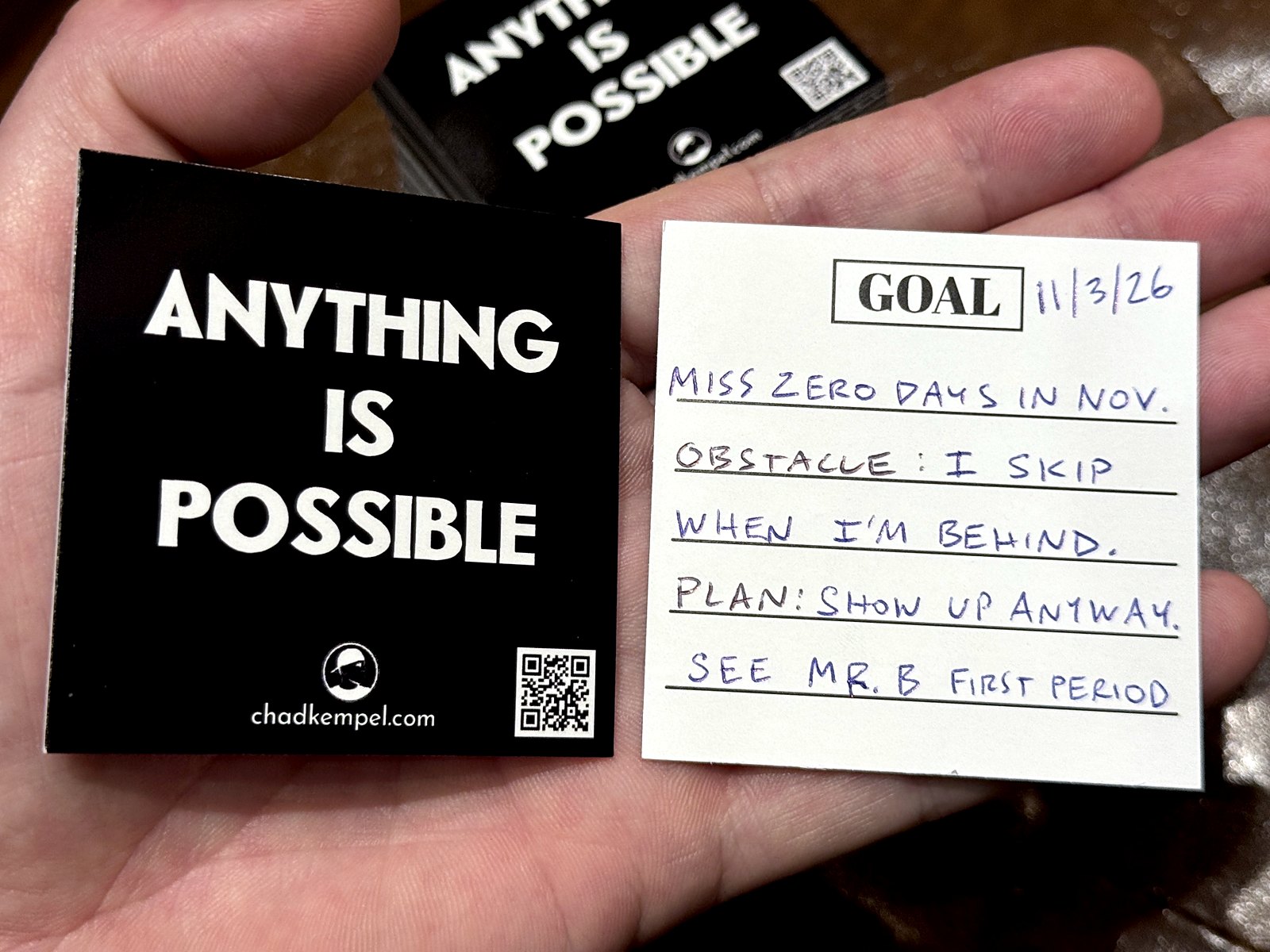
The front says Anything Is Possible, with chadkempel.com and a QR code that opens it. The back says GOAL, with blank lines and nothing else: no logo, no website, no name. Three lines, in this order.
Nobody writes on the bleachers. It’s hard to write there, and nobody writes the honest goal with the whole school looking. The card goes in a pocket, and the writing happens in the next class with a teacher in the room.
Then it goes somewhere they’ll see it. The side with Chad’s name faces out. The goal faces the wall. That’s on purpose. The front is the part they show, and the goal is the part they protect.
For the teacher who has them right after the assembly. No prep and nothing to grade.
Chad taught psychology and statistics at San Jose State University for five years. The card is built on studies he can name, and so can your counselors.
Peter Gollwitzer and Paschal Sheeran (2006) reviewed 94 studies of people who decided in advance when, where and how they’d act on a goal. Those people reached their goals more often than people who only set the goal, a medium-to-large effect on average. It worked best for getting started. That’s the PLAN line. Chad’s own version, picking the exact track and the sunrise for his last record, is in Nothing Ever Happens in This Town.
Gabriele Oettingen’s research on mental contrasting: picture the goal, then picture the thing in your way. In Duckworth, Grant, Loew, Oettingen and Gollwitzer (2011), 66 high school sophomores spent 30 minutes in English class writing out the obstacles to PSAT practice and an if-then plan for each one. Over the summer they completed more than 60 percent more practice questions than classmates who wrote about something else. That’s the OBSTACLE line.
A 2021 review by Wang, Wang and Gai of 21 studies and 15,907 people found a small-to-medium effect and warned that publication bias may have inflated it. No study on this page says one assembly changes grades, and Chad won’t tell you it does. The high school study used 30 minutes of writing in class, not a speech in a gym. That’s why the card gets filled out in class, and why your teachers get a plan.
Sources: Gollwitzer, P. M., & Sheeran, P. (2006). Implementation intentions and goal achievement: A meta-analysis of effects and processes. Advances in Experimental Social Psychology, 38, 69–119. · Duckworth, A. L., Grant, H., Loew, B., Oettingen, G., & Gollwitzer, P. M. (2011). Self-regulation strategies improve self-discipline in adolescents: Benefits of mental contrasting and implementation intentions. Educational Psychology, 31(1), 17–26. · Wang, G., Wang, Y., & Gai, X. (2021). A meta-analysis of the effects of mental contrasting with implementation intentions on goal attainment. Frontiers in Psychology, 12, 565202. · Dai, H., Milkman, K. L., & Riis, J. (2014). The fresh start effect: Temporal landmarks motivate aspirational behavior. Management Science, 60(10), 2563–2582.
Hengchen Dai, Katherine Milkman and Jason Riis (2014) tracked gym visits by 11,912 college students and found they were 47 percent more likely to show up at the start of a new semester. They called it the fresh start effect. The study was on college students, but high schools run on the same calendar. That’s the week to hold the assembly, and the card is what students do with it.
No travel fee for schools within a few hours of Boise. Anywhere else in the U.S. or abroad, send your dates for a quote within 48 hours.
Check Your Date →This page is Anything Is Possible booked for a new semester. The same talk has its own page as the resilience assembly, and it opens the three-talk series: The Weight You’re Carrying is the mental health assembly, and I Walked the Hallways Alone is the anti-bullying and belonging assembly. Or see all three talks and pricing.
Discovery calls available · Replies within 48 hours · Based in Boise, booking nationwide
Check Your Date →From Insights
Friends told me I’d die on Mt. Shasta. What I kept from the warnings, what I ignored, and a 30-minute exercise from the research that students can use on any goal.
Read the article →Get the free 10-principle guide.
Subscribe and get Anything Is Possible Was Never the End of the Sentence: 10 principles pulled from real moments, for anyone still figuring it out. Then one email when a new Insights article goes up. Unsubscribe anytime.