What should a mental health assembly do?
Get the students who are carrying something to tell an adult who can help. In 2025, one in three U.S. high school students reported persistent sadness or hopelessness, and seven in ten of them got no counseling. The assembly that moves that number gives students plain words for what they’re feeling, tells them exactly what happens after they tell someone, and names the counselor they can walk to that afternoon. It skips the shock, and it doesn’t get booked for the last period of the day.
I got slapped across the face in an eighth-grade locker room and didn’t tell anyone for twenty years. The slap, and why I kept quiet, are in my article on the freeze response. This one is about the months after.
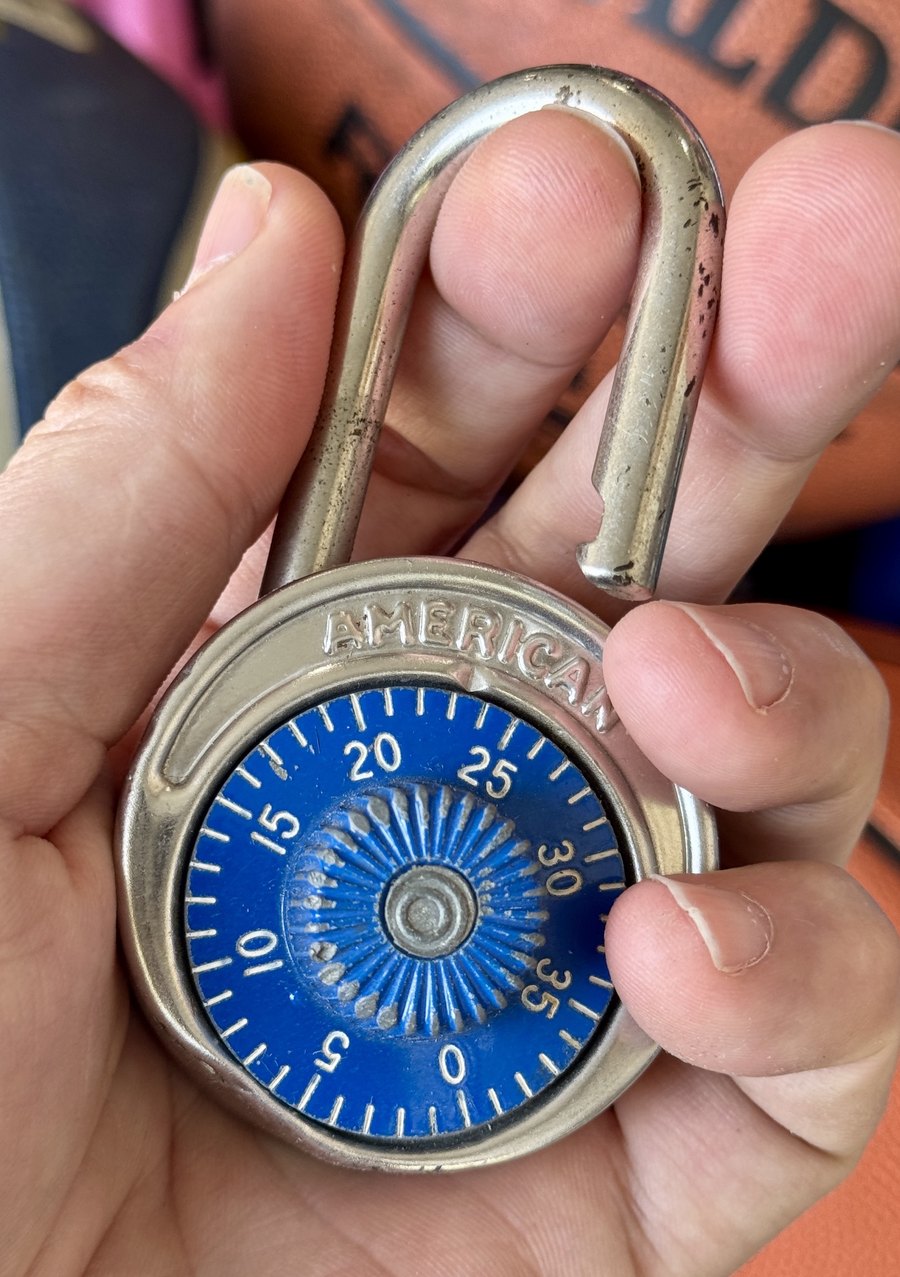
The PE teachers had an office off the locker room with a glass window, so they could see the whole room from their desks. I started timing my day around that window. I’d hang back and go in as late as I could, hoping they were already sitting in there. When class ended I changed as fast as I could and got out, because the kid who hit me might be in the next period coming in, and I wasn’t going to cross paths with him in that room again if I could help it.
I still haven’t been hit harder than that, and I figured it could be just the beginning. So I was scared for a long time. Not every minute. But it was under everything.
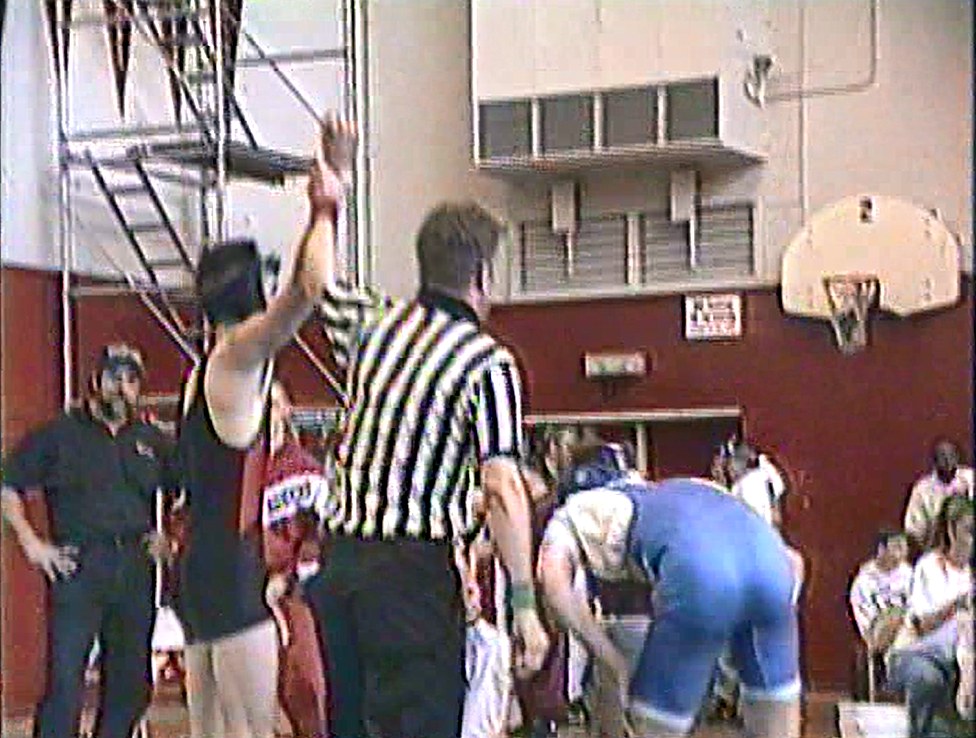
Wrestling the next year didn’t fix it. The relief people assume comes with joining a team never showed up on its own. What showed up, slowly, was strength and some skill, and by tenth grade I was confident I could handle myself. The fear of that one kid only ended when I noticed he wasn’t around anymore and figured out he’d left the school. (A different kid got me the first weeks of ninth grade, on the other side of that wall, out on the gym floor where we had PE. That one’s in my Karate Kid article.)
In tenth grade I won a match a few feet from that spot. I didn’t notice until I pulled up the old video while writing this.
The adults were behind the glass the entire time. I built my days around them, and not one of them noticed anything. From their side of the window I looked fine.
The only thing that would have gotten me into that office was somebody convincing me that telling wouldn’t bring more of it, as payback for being a snitch. If anyone had convinced me of that, I think I would have told.
What does a mental health assembly need to do?
On October 15, 2026, the CDC published a number it had never collected before. The Youth Risk Behavior Survey goes out to a national sample of high school students every two years, and in 2025 it asked, for the first time, whether students had gotten counseling or therapy in the past year.
A third of students, 33 percent, said they’d felt so sad or hopeless almost every day for two weeks or more that they stopped doing some of their usual activities. Among those students, three in ten had received counseling. Another three in ten said they’d needed it and didn’t get it, because of cost, because they didn’t know how or where to get help, or for some other reason. And four in ten said they didn’t need it.
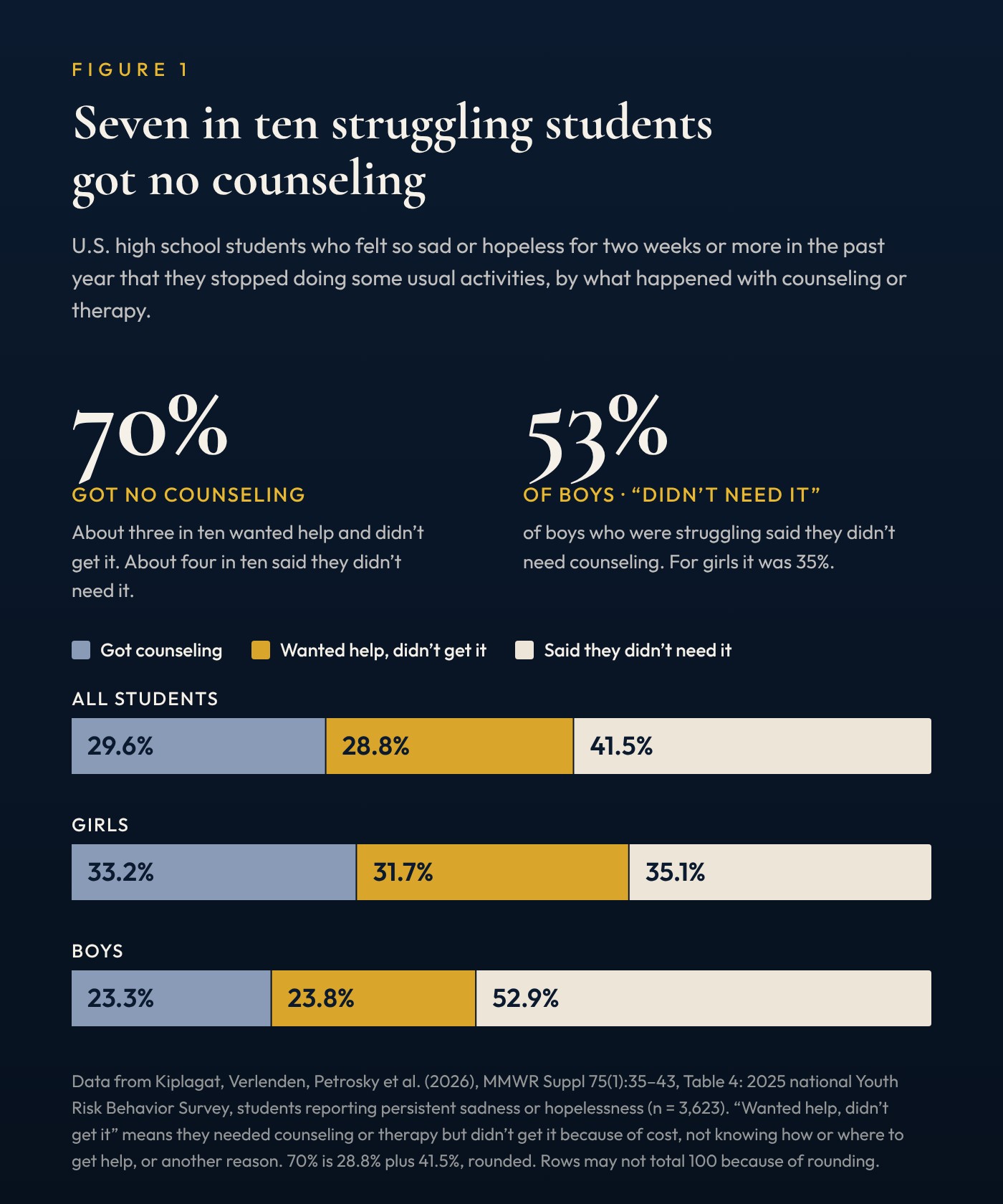
Boys drive that last number. Among boys with persistent sadness, 53 percent said they didn’t need counseling. For girls it was 35 percent.
Put that in a school of a thousand students. About 330 are carrying this. Close to 100 of them wanted help and didn’t get it, and about 140 don’t think they need it. I’d already decided telling someone would make it worse.
An assembly won’t replace a counselor. What it can do is move a kid from “I don’t need help” to “oh, that’s what this is,” and from “I don’t know what happens if I ask” to “I know exactly what happens.” Those are the two gaps in the data, and both are information a speaker can hand a gym in an hour.
Why don’t teenagers ask for help?
Researchers have asked them. Amelia Gulliver and two colleagues at the Australian National University pulled together 22 studies in 2010 on what young people themselves said kept them from getting help. Stigma came up in more than three quarters of them. The other big ones were not recognizing what they felt as a problem and wanting to handle it alone. A 2021 review of 53 studies, led by Jerica Radez at the University of Reading, found the same pattern, and its authors added a point I’d underline for any school: young people need to know what to expect from the people they’d be talking to.
My reason fits right in there. I didn’t want it getting back to him.
That’s the hole in most “reach out” messaging. It stops at reach out. Nobody told me who would hear it or what the adult would do next, so my imagination filled that in, and it said more of the same, only worse.
I can’t promise a kid that nothing bad will ever follow telling. Nobody can. What a speaker can do is walk the room through what telling looks like at that school, step by step, until the unknown stops being the scary part. That takes knowing the school’s process before I walk into the gym, which is why I meet with the counseling team first.
What should a mental health assembly never do?
Idaho’s safety guidelines for school messaging are blunter than most speakers. Three rules from them I’d hold any mental health speaker to, plus two of mine.
Don’t book it for the last period. The guidelines warn that an end-of-day assembly on a heavy topic, mental health diagnoses included, can send students home confused, with no one watching out for them. Put it earlier in the day.
Don’t build it around shock or a sad story. The guidelines say to focus on hope and help, and on how people recover. The hard part of my story is one slap and a glass window. The rest of it is what I did next.
Drop the “break the stigma” slogan. The same document says that repeating how much stigma there is can end up reinforcing it. Say something plain, like “mental health disorders are treatable,” and tell them which door to walk through.
Then mine. Don’t diagnose from the stage. A speaker who hands out labels to a gym full of teenagers is doing a counselor’s job badly. And don’t let the speaker become the resource. If a student’s only takeaway is a stranger’s Instagram handle, the school paid for a show.
Can one assembly help?
Not by itself, and I’d be wary of any speaker who says otherwise. The two strongest short programs I found weren’t assemblies. Teen Mental Health First Aid is three 75-minute sessions, and Laura Hart’s team tested it with Year 10 students at four schools in Victoria, Australia. A year later, the students who’d taken it were more willing to tell someone and get help from an adult if they were struggling. Whether they helped a friend, or got help from one, hadn’t changed. In 2022 Jessica Schleider’s group reported that one 20- to 30-minute online session, taken by 2,452 teenagers ages 13 to 16 with elevated symptoms, lowered depression scores three months later compared with a control program. That was online, one kid at a time, with nobody watching. As far as I can find, nobody has run that test in a gym. The longer version of what the research says about assemblies is in Why Most School Assemblies Don’t Stick.
So an assembly is a front door. If there’s nothing behind it, kids walk back out.
What should every student walk out knowing?
If I’ve done my job, every kid leaves with five things, and none of them is my name.
A counselor’s name and where the office is. A person and a door, and whether that door is open today.
What happens after you tell. Who hears it, what the adult does next, and just as important, what doesn’t happen. The school writes that part. I make sure students hear it from the stage.
Plain words for what they’re feeling. I teach a few psychology terms in the talk, because a kid who can say “this is my freeze response” has a handle on it.
One tool they can use tonight. Something that fits on a sticky note.
988. The crisis line, by call or text, for the kid who needs more than office hours.
And one for the adults in the building. The kid timing his day around your office window looks exactly like a kid who’s on time. The assembly’s job is to get him to knock.
Why You Freeze Under Pressure, and How to Snap Out of It →
More from Insights
Sources
- Kiplagat, S. J., Verlenden, J. V., Petrosky, E., et al. (2026). Unmet need for mental health services among high school students experiencing persistent feelings of sadness or hopelessness: Youth Risk Behavior Survey, United States, 2025. MMWR Supplements, 75(1), 35–43. Figure 1 uses Table 4.
- Gulliver, A., Griffiths, K. M., & Christensen, H. (2010). Perceived barriers and facilitators to mental health help-seeking in young people: A systematic review. BMC Psychiatry, 10, 113.
- Radez, J., Reardon, T., Creswell, C., Lawrence, P. J., Evdoka-Burton, G., & Waite, P. (2021). Why do children and adolescents (not) seek and access professional help for their mental health problems? A systematic review of quantitative and qualitative studies. European Child & Adolescent Psychiatry.
- Hart, L. M., Morgan, A. J., Rossetto, A., Kelly, C. M., Gregg, K., Gross, M., Johnson, C., & Jorm, A. F. (2022). teen Mental Health First Aid: 12-month outcomes from a cluster crossover randomized controlled trial. BMC Public Health, 22, 1159.
- Schleider, J. L., Mullarkey, M. C., Fox, K. R., et al. (2022). A randomized trial of online single-session interventions for adolescent depression during COVID-19. Nature Human Behaviour, 6(2).
- Idaho Lives Project and Idaho State Department of Education (updated 2022). Safety Guidelines for Schools.
From Insights by Chad Kempel. Read it online at chadkempel.com/insights/mental-health-assembly-high-school/
Get the free 10-principle guide.
Subscribe and get Anything Is Possible Was Never the End of the Sentence: 10 principles pulled from real moments, for anyone still figuring it out. Then one email when a new Insights article goes up. Unsubscribe anytime.
Just want the guide? It’s $1, no email needed.