Do school assemblies work?
Mostly no, and the research is specific about why. School programs that work for younger kids lose their effect around eighth grade, and what stops working is the telling: an adult on a stage explaining what teenagers should do. The assemblies students still talk about a week later hand over the evidence and a story and let the room decide.
Around eleventh grade, a team of bodybuilders came to our gym at my high school. They played pump-up music, and while one of them bent pans and rebar, his partner waved his arms at the bleachers to get the applause going. We gave them plenty. They kept asking for more than we were giving.
Then one of them turned to the girls and made a crude joke about their boyfriends. The gym went quiet. That’s the only thing any of them said that I still remember, and as far as I know, nobody talked about the assembly afterward.
The rest of my assemblies blur together. There was D.A.R.E. back in elementary school, and senior week had a wrecked car on the front lawn, which I’d already seen the year before when they set it out for the class ahead of us. Grad night came with an assembly about not drinking and driving and a crash video nobody could look at for long.
I wanted what every one of those speakers had anyway. They all had a story, either something amazing they’d done or something awful they’d survived, and they’d come out the other end with a lesson to hand the rest of us. It never once crossed my mind that I could be the one up there.

I spent the first half of my thirties at the front of a room. I taught psychology and statistics at San Jose State University for five years, some semesters to 125 students at a time, which feels like a big room right up until you stand in a high school gym. A gym can hold ten of those. And the people in it didn’t sign up for the class. They’re fourteen to eighteen, and every one of them is watching everyone else.
So before I built a talk for that room, I went and read what the research says about it. The honest answer isn’t flattering to assemblies, and I’m building three of them.
What does the research say about school assemblies?
In 2018, David Yeager, Ronald Dahl and Carol Dweck published a review in Perspectives on Psychological Science with a title that gives the game away: Why Interventions to Influence Adolescent Behavior Often Fail but Could Succeed. They went through the meta-analyses of the standard school prevention programs, the ones on healthy eating, depression, bullying and social skills, and found the same shape in every one. The programs do some good with children and early adolescents. By middle adolescence, which they put at roughly ages 13 to 17, the average effect drops to about zero.
They name assemblies. Their table of what a traditional program looks like lists “whole-school assemblies” right beside classroom lectures, skits, and homework. And in the section on how programs deliver their message, they write that heavy-handed formats, “lectures, assemblies, homework,” may backfire “even when they are disseminating relevant information.” Many teenagers already know the information. Hearing it again, from an adult, in several formats, reads as being treated like a child.
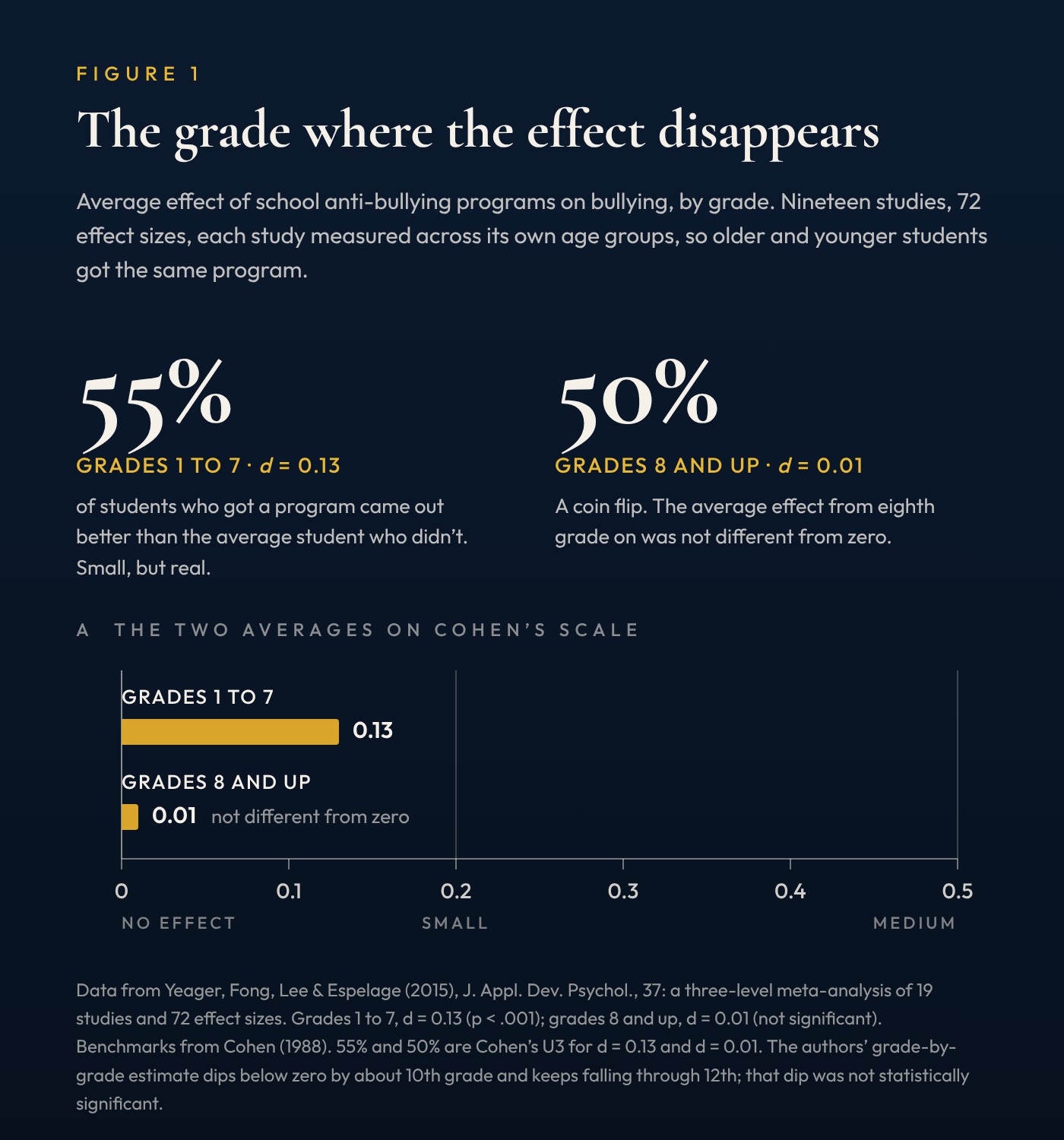
The cleanest numbers come from a 2015 meta-analysis Yeager led on anti-bullying programs with Carlton Fong, Hae Yeon Lee and Dorothy Espelage. Nineteen studies, 72 effect sizes, and the useful part is that each study measured the same program across different ages, so this isn’t older kids getting a worse program. Through seventh grade the programs reduced bullying by a small but real amount, an effect size of 0.13. From eighth grade on it was 0.01, which is nothing. The authors’ own grade-by-grade estimate dips below zero by about tenth grade. That dip wasn’t statistically significant, and they say so, but they also say they can’t yet recommend relying on these programs for eighth grade and up.
Two caveats before anybody cancels anything. Most of the programs in that analysis were whole-school packages that schools adopted and ran, with rules and classroom lessons, not a single speaker. The 2018 review traces the problem to the design they shared: adults explaining to teenagers what they should do. And the review’s authors are careful people. They write that they’re not saying no traditional program has ever worked with teenagers, only that the ones that have been studied haven’t worked on average. As far as I can find, nobody has run a controlled study of a single 45-minute assembly built the way they recommend. I’d like to see one. If a research team ever wants a guinea pig with a microphone, I’ll volunteer, and they can publish whatever they find.
Laurence Steinberg, in the same journal three years earlier, put it more bluntly: classroom-based health education “is an uphill battle against evolution and endocrinology.”
Why do school programs stop working in high school?
Yeager, Dahl and Dweck’s answer is that somewhere in puberty, feeling respected and having standing with your peers moves to the front of the line. Not ahead of everything, but ahead of long-term health and ahead of whatever an adult thinks is good for you. People feel respected, the review says, when they’re treated as competent, given some say over their own choices, and treated as worth something to the group. A program that walks in and tells a fifteen-year-old what to do leans on all three at once.
The evidence they line up is physical as much as psychological. Testosterone climbs in both boys and girls during puberty, and the research they cite ties it to the drive to seek status and defend it. Teenagers also change their minds about who gets to decide. Yeager’s team went back to a 1998 study by Ruck, Abramovitch and Keating and worked out that about half of kids aged 8 to 12 thought an adult should respect a teenager’s right to make a call for himself. Among 14-to-16-year-olds it was nearly three quarters. Eighth grade, they note, is where the gap is widest between what teenagers think they should get to decide and what adults think they can handle.
My own kids are still on the other side of that line. I asked the seven of them what they remembered from assemblies at their school, and even in elementary school the slope had started. The first graders went home repeating the jokes, while the fourth graders were bored and just wanted the yo-yo.
Psychologists have had a name for the push-back since 1966, when Jack Brehm called it reactance: when people feel a freedom being taken away, they push to get it back, sometimes by doing the exact thing they were told not to. Adults do it too. Teenagers just have more freedom on the line.
One small brain-imaging study, 28 kids between 9 and 17, played each kid a recording of their own mother criticizing them: the regions tied to emotional reaction got busier, and the ones used for thinking a problem through got quieter. The review’s authors add the caution themselves: research hasn’t definitively shown that the format of a message, on its own, is what threatens respect. The research points there. It hasn’t proved it.
What does a gym full of teenagers do to a message?
In 2013 Leah Somerville and her colleagues put 69 people between the ages of 8 and 22 in a brain scanner and told them a camera inside it was sending their face to a peer their own age. Some of the time a screen showed the camera as off, some of the time as on. There was no camera. The teenagers showed more embarrassment than the children from nothing more than believing they were being watched, their bodies showed a stress response the children’s didn’t, and the effect eased off again in the adults. David Elkind named this the imaginary audience back in 1967, and he and Robert Bowen put numbers on it in 1979. In a gym the audience is real: fifteen hundred people, all facing the same way.
That changes what a message can do. The kid two rows down isn’t deciding whether the speaker is right. He’s deciding what his face is doing. Being seen to agree with the adult on stage can cost him something with the people beside him, and nodding along is a risk he didn’t sign up for.
I know what mine did. I matched the crowd. If something was funny and nobody laughed, I didn’t either, and on anything serious or personal I froze and made sure my reaction looked right. I don’t think I decided any of that. I just did it.
Ask my kids and you get the other end of the curve. All seven remember speakers picking students to come up on stage, and all seven would have gone up. Looked like fun, they said. The ten-year-old wants a personal story, and something she could go home and teach the family. The twelve-year-old is already drifting toward the high school answer. Asked what would make her listen to an adult with a microphone, she said somebody who’d been through something real, and a room where everyone got to take part, because when one kid gets picked she just gets jealous.
Part of the answer, oddly, is to stop making anyone show anything they didn’t choose to. The approaches that worked in the review did most of their work on paper, where no one could see a student agree. The speaker who hauls a kid up on stage to make a point is working against the one thing the scanner study shows most clearly.
What makes a school assembly effective?
Yeager, Dahl and Dweck put the successful approaches next to the traditional ones in a table, and the right-hand column reads like a recipe. It lists stories of people who were aggressive or shy and learned another way to be, the scientific evidence for how that was possible, stories from peers who found the information useful, and a writing exercise where the student makes the argument in their own words. What none of it does is tell the teenager what to do. The methods, they write, “do not ‘tell’ adolescents what to do and not do, so much as they invite adolescents to ‘discover’ the meaning of the messages for their own lives.”
The example they walk through is a junk food study. Christopher Bryan, Yeager and their colleagues gave more than 450 eighth graders a 30-minute packet to work through in class. One group got the standard healthy-eating material from the federal MyPlate program. Another got an exposé: how food companies pay scientists to engineer snacks to be addictive, how they market them to little kids, how the executives won’t let their own children eat the stuff. Then quotes from older, high-status students who’d read the same article and sworn off junk food in protest. Then the students wrote a letter to a future student explaining what they planned to do about it. Nobody told them to eat an apple.
The next day the school handed every eighth grader a snack menu as a reward for good behavior during state testing, fruit and water on one side, Hot Cheetos, Oreos and Coke on the other. The exposé group picked about 9 percent less sugar than both control groups, which didn’t differ from each other. That’s a small effect, a d of 0.20, measured one day later, and the review says so. The part that matters for a gym is why it worked, and the study measured that too. Passing on junk food had become a way to stand up to the food companies. That made it the choice that earned respect, and that’s what moved the snack choices.
The smallest example in the review is one sentence long. Seventh graders got their essays back from their social studies teachers with a handwritten note from the teacher. Half the notes said the comments were there so the student would have feedback on the paper. The other half said: “I’m giving you these comments because I have very high expectations and I know that you can reach them.” The students who got the second note were far more likely to revise their essays, and it mattered most for the kids who trusted school the least. Forty-four seventh graders, so it’s a small study, but that’s a sentence any teacher can write tonight.
One more thing from the review surprised me. Two meta-analyses by Eric Stice and colleagues found that shorter programs tended to have stronger effects than longer ones, and Yeager, Dahl and Dweck’s guess at why is that a long program can signal that the adults think you’re incompetent. So an hour, by itself, isn’t the weakness people assume. The authors are careful to add that longer programs can work too, when they’re built with the same respect.
None of these were assemblies. That’s a real gap in the research, and anybody pitching you an assembly ought to admit it. They were a packet in a classroom and a note on an essay. What they share is the design: evidence the student can weigh, a story from someone who changed, a peer’s voice, and a chance for the student to put the conclusion in their own words. That’s the column I built from. The goal cards I hand out at my talks come straight from the last item. Nobody writes the goal for the student. They write it themselves, in the next class, and the research on why a written plan with a time and a place on it holds is on the goal-setting assembly page.
How can teachers make an assembly stick?
Every one of my kids remembers the yo-yo guy’s acronym. Y.E.T. Not one of them can tell you what the letters stood for. What they do remember is the teacher who kept bringing the assembly back up in class whenever something related happened, a bullying incident, that kind of thing. Those were the kids still talking about it afterward, and my ten-year-old says it changed something. She doesn’t give up as fast. The memory research says that’s no accident.
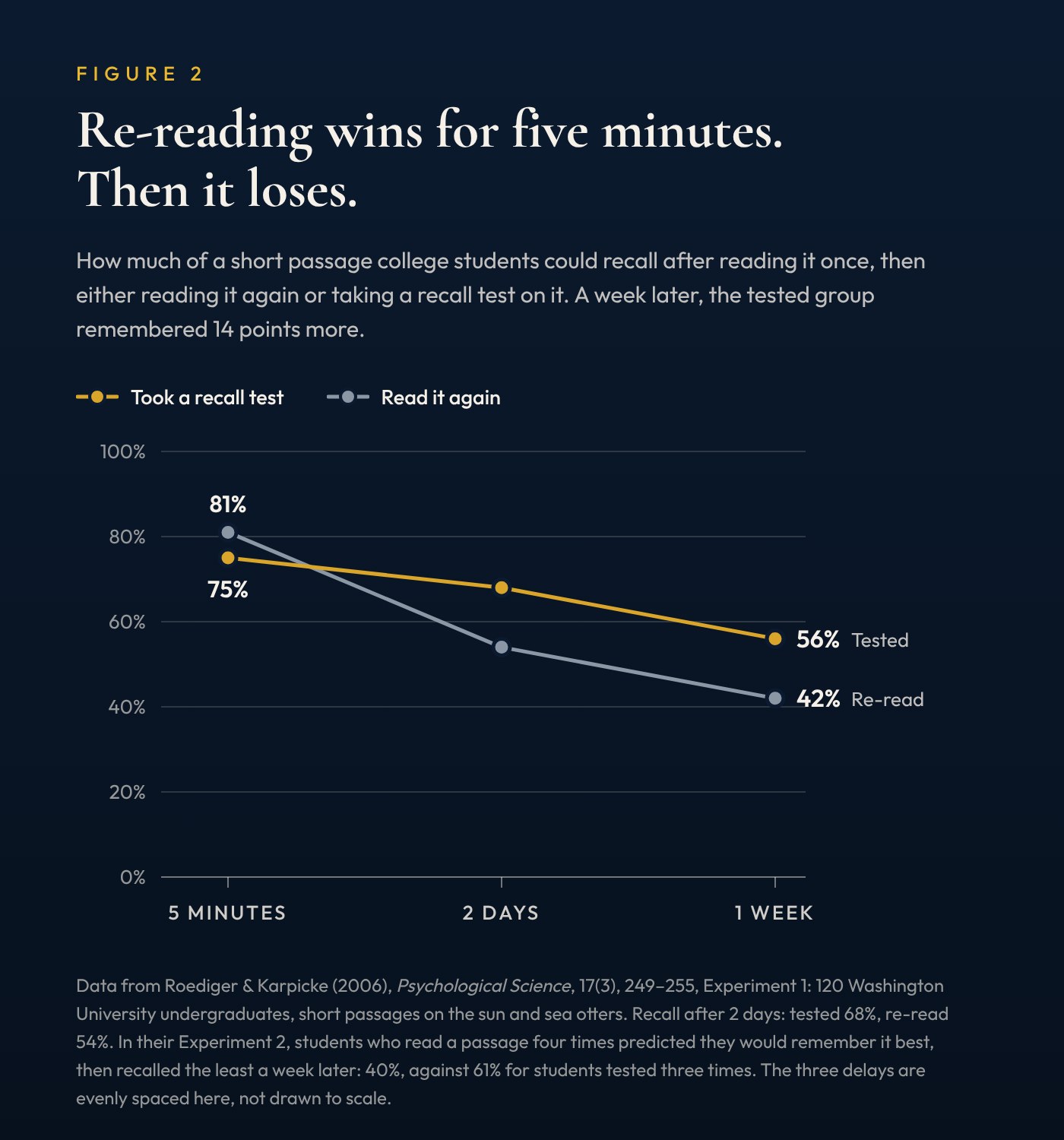
In 2006 Henry Roediger and Jeffrey Karpicke had college students at Washington University read short passages, then either read them again or take a test on them. Five minutes later the re-readers did a little better. A week later the students who’d been tested remembered 56 percent of the ideas and the re-readers 42, and students who were tested three times held 61 percent against 40 for students who read the passage four times. The re-readers were also the most confident they’d remember it. They remembered the least. That was college students reading prose passages, so carry it over to fifteen-year-olds and a speaker carefully. But having to remember a thing beats hearing it again.
So the next morning, don’t replay the assembly. Ask the room what they remember. What did he actually say? Which part would you argue with? Five minutes, no slides. Then let them write their own version of it, which is where the goal card gets filled in. The next-morning plan for each of my talks is on the educator page, and it’s written for the teacher who wasn’t in the gym.
I built my own talks around the two public failures that came before my first Guinness World Records title and the near-miss psychology that explains why missing the record by only four minutes hurt worse than missing it by forty-six. Then a card the student fills in the next day, in their own words. If the research is right, the most an adult on a stage can do for a fifteen-year-old is make the better choice look like the kid’s own idea, and then get out of the way. In the junk food study, nobody told those eighth graders to pick the water. The next day, seven more out of every hundred did.
Questions to ask a school assembly speaker before you book
Pulled from the research above. Use them on any motivational speaker, mental health speaker or performer you’re considering for a high school assembly. A good one answers all of them without blinking.
Does the talk tell students what to do, or hand them the evidence and let them decide? By eighth grade, telling is the part that stops working.
Is there a story of someone who changed, with the evidence for how? The successful approaches in the review’s table had both. A story without the how is a poster.
Do students get a real part in it? In the junk food study, older, high-status students carried part of the message. Ask whether student leaders have a role: introducing the talk, opening the Q&A, or leading the follow-up in class.
Will students put the message in their own words afterward? In the junk food study, the students wrote a letter to a future student in their own words. If the only writing is the speaker’s slides, something is missing.
Does anyone get put on the spot? Teenagers react to being watched in a way children don’t. Volunteers who want the stage are one thing. A kid singled out to prove a point is another.
What happens the next morning? Ask for the classroom follow-up and whether a teacher can run it in five minutes. Memory research says having to remember it beats hearing it again.
What fills the hour? In the research, shorter programs beat multi-week ones, and a single talk is already the short end. So the length matters less than what’s in it.
Bullies Don’t Pick Fights. They Pick Targets. →
More from Insights
Sources
- Yeager, D. S., Dahl, R. E., & Dweck, C. S. (2018). Why interventions to influence adolescent behavior often fail but could succeed. Perspectives on Psychological Science, 13(1), 101–122. A free author manuscript is on PubMed Central.
- Yeager, D. S., Fong, C. J., Lee, H. Y., & Espelage, D. L. (2015). Declines in efficacy of anti-bullying programs among older adolescents: Theory and a three-level meta-analysis. Journal of Applied Developmental Psychology, 37, 36–51.
- Steinberg, L. (2015). How to improve the health of American adolescents. Perspectives on Psychological Science, 10(6), 711–715.
- Steindl, C., Jonas, E., Sittenthaler, S., Traut-Mattausch, E., & Greenberg, J. (2015). Understanding psychological reactance: New developments and findings. Zeitschrift für Psychologie, 223(4), 205–214. Brehm first proposed reactance theory in 1966.
- Lee, K. H., Siegle, G. J., Dahl, R. E., Hooley, J. M., & Silk, J. S. (2015). Neural responses to maternal criticism in healthy youth. Social Cognitive and Affective Neuroscience, 10(7), 902–912.
- Somerville, L. H., Jones, R. M., Ruberry, E. J., Dyke, J. P., Glover, G., & Casey, B. J. (2013). The medial prefrontal cortex and the emergence of self-conscious emotion in adolescence. Psychological Science, 24(8), 1554–1562.
- Elkind, D., & Bowen, R. (1979). Imaginary audience behavior in children and adolescents. Developmental Psychology, 15(1), 38–44.
- Bryan, C. J., Yeager, D. S., Hinojosa, C. P., Chabot, A., Bergen, H., Kawamura, M., & Steubing, F. (2016). Harnessing adolescent values to motivate healthier eating. Proceedings of the National Academy of Sciences.
- Yeager, D. S., Purdie-Vaughns, V., Garcia, J., Apfel, N., Brzustoski, P., Master, A., Hessert, W. T., Williams, M. E., & Cohen, G. L. (2014). Breaking the cycle of mistrust: Wise interventions to provide critical feedback across the racial divide. Journal of Experimental Psychology: General, 143(2), 804–824.
- Roediger, H. L., & Karpicke, J. D. (2006). Test-enhanced learning: Taking memory tests improves long-term retention. Psychological Science, 17(3), 249–255.
From Insights by Chad Kempel. Read it online at chadkempel.com/insights/do-school-assemblies-work/
Get the free 10-principle guide.
Subscribe and get Anything Is Possible Was Never the End of the Sentence: 10 principles pulled from real moments, for anyone still figuring it out. Then one email when a new Insights article goes up. Unsubscribe anytime.
Just want the guide? It’s $1, no email needed.